

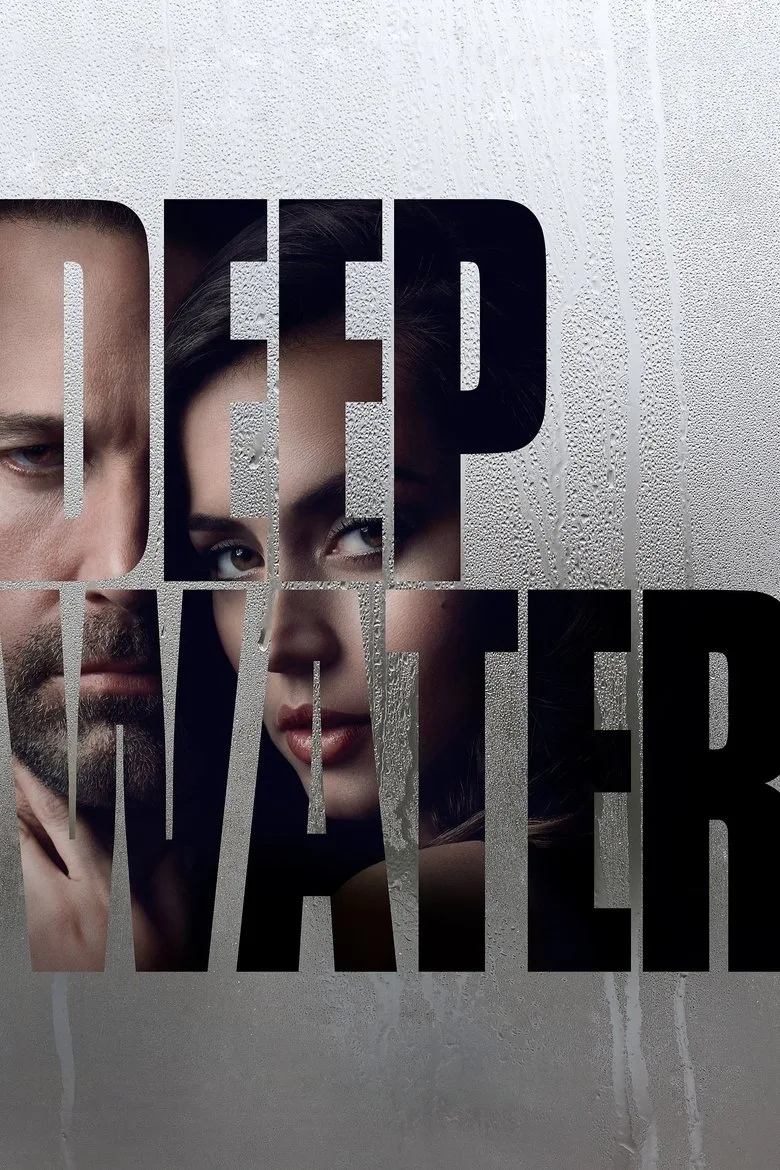
Deep Water 2022 Review
When director Adrian Lyne teams up with stars of the caliber of Ben Affleck and Ana de Armas, audiences expect a tension-charged thriller bristling with desire. Yet Deep Water, the 2022 film released on Hulu after Lyne's nearly twenty-year absence from directing, delivers far less than its posters and its stars promised. It is a film that sits in a strange grey zone — neither a tightly crafted thriller nor a deep psychological drama, but something in between that fails to convince on either front.
The Story
Adapted from the novel of the same name by Patricia Highsmith, the film follows Vic Van Allen (Ben Affleck), a quiet and wealthy man living in a luxurious home with his wife Melinda (Ana de Armas) and their young daughter. The marriage appears stable on the surface, but is in reality an unspoken arrangement: Melinda pursues affairs outside the marriage in a near-open fashion, and Vic turns a blind eye — on one condition: that the balance of their household is never threatened.
Events are set in motion when Vic begins hinting to his wife's friends that he was responsible for the disappearance of one of her former lovers — a remark he delivers with an unsettling coldness, as though he is playing a game in which he holds all the cards. When another lover dies under mysterious circumstances, their neighbor Don (Tracy Letts) begins to regard Vic with mounting suspicion. This narrative thread — the suspect husband and the self-appointed investigating neighbor — could have been the backbone of a tightly wound thriller, but the film never quite figures out how to build it with coherence.
The fundamental problem with the screenplay, written by Zach Helm and Sam Levinson, is that it presents Vic as a character almost entirely emotionally detached from the world around him, without giving the audience a compelling reason to draw closer to him or understand him. The mystery surrounding the character is supposed to be a source of fascination, but it frequently turns into a kind of flatness that distances the viewer rather than drawing them in.
Performances
Ben Affleck plays Vic with a deliberate calm and coldness — a logical choice for the character — but he sometimes lacks the internal layers that would make this detachment genuinely interesting. There are moments where Affleck seems truly engaged with the role, particularly in scenes where he exchanges loaded glances with those around him, but there are other moments where a distance seems to exist between him and the film itself.
Ana de Armas as Melinda is unquestionably the most commanding presence on screen. She portrays a complex, contradictory woman — one who loves her husband in her own way and destroys him in her own way too — with a certain vitality and boldness. Yet the screenplay does not grant her sufficient depth to make her behavior understandable or even genuinely thought-provoking; she is written more as a catalyst for events than as a person with clear inner motivations.
Tracy Letts, by contrast, plays the suspicious neighbor with a light, entertaining energy, and delivers what is perhaps the most well-balanced performance in the film despite his limited screen time.
Direction and Cinematography
Adrian Lyne's return to directing after a long absence was much anticipated. Lyne is known for films such as Fatal Attraction and Unfaithful, which share with Deep Water a climate of infidelity and painful desire. Here, Lyne demonstrates an undeniable mastery in crafting visual tension and creating an atmosphere that quietly suggests approaching danger. The camera moves with measured deliberateness, and the exterior scenes set in lavish homes and at parties reinforce a feeling that surface beauty conceals something rotten underneath.
However, the pacing poses a major obstacle. The film is slow to a degree that exceeds what its story can sustain; it is not enough for the details to be visually beautiful if the screenplay does not feed them with content worthy of such contemplation. Several scenes run longer than they should without adding anything of note, leaving the viewer with an unwarranted sense of heaviness at certain points in the film's middle stretch.
Stéphane Fontaine's cinematography works well in employing light and shadow to create a visual register that suits the story, and the score composed by Natalie Holt contributes to building tension, though it occasionally leans on familiar solutions common to the thriller genre.
Strengths and Weaknesses
Among the film's notable merits is that it does not try to offer a conventional hero who is easy to sympathize with, or a clear villain who is easy to despise. This moral ambiguity gives the film a critical dimension that sets it apart from many marital thrillers. The film also raises — if only in incomplete fashion — intriguing questions about the nature of relationships when they devolve into silent power struggles, and about the psychological cost of unspoken marital arrangements.
But the film suffers from structural problems that are difficult to overlook. First, the screenplay fails to build dramatic tension in a well-paced, escalating way; the major scenes sometimes arrive without sufficient setup, making them feel disconnected from their context. Second, the film's ending disappoints: events conclude in a manner that feels rushed and lacks the force the viewer anticipated after all that slow accumulation. Third, the relationship between Vic and Melinda — despite being the heart of the film — remains on the surface far more than it plunges into its depths, which is difficult to accept in a film called Deep Water.
The chemistry between Affleck and de Armas — who did in fact become romantically involved during the production — surfaces in moments, but it is neither consistent nor convincing throughout the film. Some of the intimate scenes are shot with boldness, yet they feel disconnected from the emotional context of the two characters.
Final Verdict
Deep Water is a film that carries within it genuine potential that never fully materializes. The raw ingredients are all there: a compelling story drawn from a classic novel, a director with proven experience in the genre, and two stars with undeniable screen presence. Yet the final product remains less than the sum of its parts — a film that sparks your curiosity at certain points and exhausts it at others, leaving no lasting impression once the end credits roll.
It is better than its low ratings on some platforms suggest, but falls far short of what it could have been. If you are a fan of psychological marital thrillers and can tolerate a measured pace and an unsatisfying ending, you may find it decent enough viewing. Those in search of a fully realized, tightly constructed thriller experience, however, would be better served looking elsewhere.
Rating: 5.5 out of 10 — A middling film that squanders genuine opportunities through excessive slowness and a screenplay that never rises to the level of its subject matter.
📝 This article is an editorial piece based on publicly available information about the film. The author's opinions do not necessarily represent the platform's position, and some details may differ from official sources.