

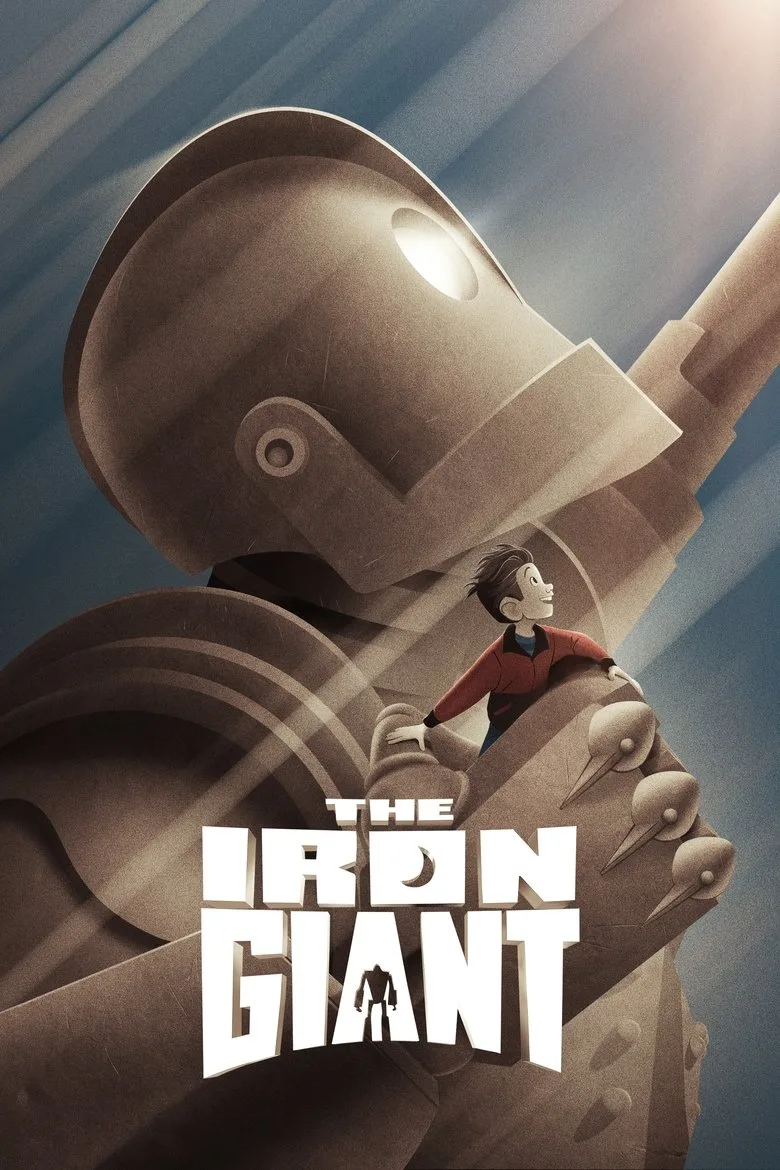
The Full Story of The Iron Giant 1999
Introduction to the Film
In 1999, director Brad Bird introduced the world to The Iron Giant, an animated feature that blends emotional drama and science fiction within a deeply resonant family framework. The film is set in the autumn of 1957, a period charged with political and social tension in the United States, when the Cold War between Washington and Moscow was at its peak and fear of outside invasion gripped the hearts of many Americans. The film masterfully exploits this historical backdrop to raise fundamental questions about identity, fear, and sacrifice, presenting them through the relationship between a young boy and a massive alien machine.
The film traces its origins to a novel by British poet Ted Hughes titled "The Iron Man," published in 1968, though the screenplay added new dimensions suited to the American context, lending the story a more human and emotionally rich character. The film was produced by Warner Bros. Animation and did not achieve major commercial success upon its theatrical release, yet over the years it has earned a firm place among cinema lovers, who regard it as one of the most impactful and profound animated films in the history of American cinema.
Plot of the Film
The story begins on a stormy night when a massive, unidentified object crashes into the waters near the small town of Rockwell, Maine. A fisherman witnesses the impact and reports it, triggering a wave of panic and speculation among the townspeople. Amid this collective unease, nine-year-old Hogarth Hughes lives with his working mother, Annie, in a modest apartment. Hogarth is a curious and adventurous boy who loves comic books and science fiction films, finding in imagination a refuge from the absence of his father, whom he lost at an early age.
One night, Hogarth notices that part of his home's television antenna has been eaten away, and he heads into the nearby forest to find the cause. There, he encounters the surprise of a lifetime: an enormous iron giant standing dozens of meters tall, who appears confused and hungry, devouring every piece of metal he can find. Despite the machine's colossal size and the initial terror Hogarth feels, the boy quickly realizes that this alien being harbors no aggressive intentions — he seems naïve and in need of guidance.
The friendship between Hogarth and the Giant develops gradually and movingly. The boy teaches the Giant to speak and introduces him to basic concepts about the world — objects, actions, and emotions. He takes him to the scrapyard run by bohemian artist Dean McCoppin, who becomes an ally to both after coming to understand the Giant's true nature and believing in his harmlessness. Dean's large storage facility becomes a hiding place for the massive Giant, safely away from the eyes of the townspeople and the authorities.
At the same time, a character named Kent Mansley arrives in town — a government agency agent tracking reports and accounts related to the fallen object. Mansley is a man consumed by paranoia, who sees in everything unfamiliar a threat to national security. He begins investigating quietly, interrogating residents and picking up clues that gradually lead him toward Hogarth and the Giant. This agent represents, within the film, the face of institutional fear driven more by delusion and exaggeration than by reason.
Events unfold along a dual track: on one hand, the friendship between Hogarth and the Giant grows deeper and more intimate, as the Giant learns the meaning of death through a poignant scene in which they witness a deer fall in the forest. On the other hand, Mansley tightens his grip and gathers evidence. Hogarth discovers by chance that the Giant harbors within him immense destructive capabilities that activate automatically when he feels threatened, stirring in the boy a deep anxiety about the true identity of his friend: is he a weapon, or a free being capable of choosing his own fate?
The crisis reaches its peak when Mansley reveals the Giant's existence to the U.S. military, which sends its forces to surround the town and eliminate what it considers a potential threat. Hogarth and Dean attempt to convince the military that the Giant is harmless, but the situation explodes when the boy is injured in a confrontation, awakening the Giant's self-defense protocol and causing destructive weapons to emerge from within him — confirming in the military's eyes his danger and sealing the decision to destroy him.
In the final sequence, after one of the officials fires an unstoppable nuclear missile toward the town, the Iron Giant chooses to intercept the missile with his own body in space, sacrificing himself to save the city and everyone in it. Before he ascends, he recalls the words Hogarth had spoken to him about Superman: "You are what you choose to be." He utters that phrase in a quiet, resolute voice before hurling himself toward his fate.
Most Memorable Scenes
The film holds a number of scenes that carve themselves deeply into the viewer's emotional memory. Among the most notable is the scene of the fallen deer in the forest, where the Giant innocently asks Hogarth about the nature of death. The boy explains in simple words that all living things die someday, but that the "soul" remains. The enormous machine pauses at this concept with something resembling philosophical sorrow, in a moment that makes the viewer realize this "giant" carries within him a consciousness far more tender than his appearance suggests.
No less significant is the scene in which Hogarth calms the Giant after his internal weapons activate automatically during a mock war game with the other children. The Giant is struck with shock and horror at what he nearly did, and is on the verge of tears. Here the viewer grasps the dilemma of the machine's identity: he is designed to be a weapon, yet with every ounce of his consciousness he refuses that role.
The most painful and profound scene of all is the final sacrifice, as the Giant soars toward the nuclear missile in the bright sky, eyes open and wearing a calm smile, sending forth within himself that single word: "Superman" — signaling his choice to be a hero rather than a weapon, a being rather than a tool. This scene is considered one of the most enduring and affecting moments in the history of animated cinema for general audiences.
Also standing out near the film's end is a warmly luminous moment of hope, when it becomes clear that the Giant's scattered parts from around the world are slowly moving toward one another, suggesting that the Giant has not fully perished and that his reunion with Hogarth is not far off. That moment balances the weight of loss with an undying flame of hope.
Message and Meaning
The Iron Giant offers multiple layers of meaning that can be read on different levels. On the surface, it is a story of an unlikely friendship between a boy and a machine. But at its core, it is a dramatic exploration of an age-old question: is identity fate or choice? The Iron Giant embodies this question in its clearest form; he is built to be a destructive weapon, yet he rejects that definition and chooses love and protection over destruction.
The film also examines the phenomenon of collective fear and how easily it can transform into blind hostility. Mansley represents the government and the institution that sees in anything different only a potential threat to be neutralized, even when genuine evidence of danger is entirely absent. This dimension makes the film an implicit critique of Cold War culture and the climate of dread that defined it, in which anything incomprehensible became an enemy by definition.
On the human level, the film carries a clear message about the value of sacrifice. The Giant chooses to die in order to save many people — among them those who originally sought to destroy him. This choice is not mere heroism; it is an embodiment of a profound concept of goodness that demands no reciprocity. What makes it all the more poignant is that this sacrifice comes from a being who has only just learned the meaning of life and death, and who nonetheless offers the latter without hesitation.
The film also touches on an educational dimension through the lens of Hogarth's relationship with the Giant. The boy who lacks a father finds in the enormous machine a companion through whom and with whom he learns. Conversely, the Giant who knows nothing of the human world finds in Hogarth a teacher who gives him a moral compass. This reciprocal learning relationship is presented with genuine warmth, free from heavy-handedness or moralizing.
Taken as a whole, The Iron Giant poses a question that lingers in the viewer's mind long after the film ends: in a world built on fear, categorization, and preparation for war, does the individual — whether human or machine — possess the capacity to choose to be something better than what society or nature has made them? The answer the film offers is clear and resolute: yes, and that choice is the very essence of humanity.
📝 This article is an editorial piece based on publicly available information about the film. The author's views do not necessarily represent the platform's position, and some details may differ from official sources.