

Introduction
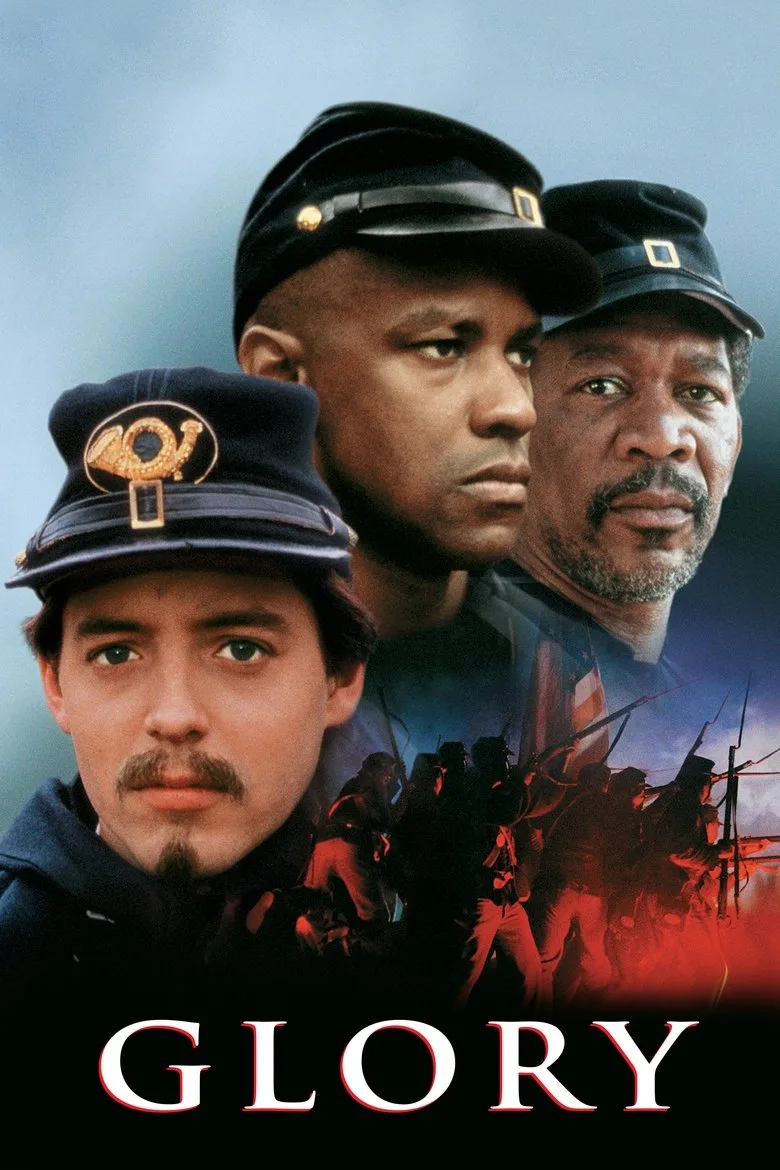
Glory, released in 1989 and directed by Edward Zwick, starring Matthew Broderick, Denzel Washington, and Morgan Freeman, stands as one of the most honest and humanly profound cinematic works ever made about the American Civil War. The film is built on documented historical events and draws its story from personal letters written by Colonel Robert Gould Shaw, as well as from two books: Lincoln and the Negro by Benjamin Quarles and Lay This Laurel by Peter Burchard. Glory is not merely a war film depicting battles and confrontations; it is a human testimony to the experience of a group of men who fought for freedom at a time when the entire world questioned their fitness to fight — and even their humanity itself.
The story begins in the midst of the American Civil War, fought between the North and the South, specifically during the period between 1862 and 1863. The film takes as its central dramatic focus the formation of the 54th Massachusetts Infantry Regiment — the first combat military unit composed of Black soldiers in the Union Army.
The Story
The Beginning: A Young Man Faces the Fire of War
The film opens at the famous Battle of Antietam in 1862, where young officer Robert Gould Shaw finds himself in the heart of a bloody and terrifying carnage. He is wounded and left on the battlefield among the dead, only to awaken later and realize he has miraculously survived. This painful experience plants deep questions within him about the meaning of courage, duty, and justice.
After returning to Boston to recover, he is offered an unprecedented assignment: commanding the first regiment of Black volunteer fighters. Shaw hesitates at first, fully aware of the weight of this responsibility and the immense social and military challenges it entails. But in the end he accepts the mission, driven by his belief in the justice of the abolitionist cause and his conviction that these men deserve a chance to prove themselves.
Forming the Regiment: A Battle Before the Battle
The training phase begins, forming the backbone of the film's first half. Men from vastly different backgrounds join the regiment — some born free and educated, others who had lived in the shackles of slavery and carried its scars on both body and soul. Among the most prominent is Private Trip, played by Denzel Washington with a sharp and aching performance: a formerly enslaved man who carries an indescribable bitterness and a constant suspicion of white men's intentions, even those who are sympathetic. There is also Sergeant Mulcahy, portrayed by Morgan Freeman with quiet, mature leadership — an educated man who believes this regiment may be a step toward real change.
The training was far from easy. The stern drill sergeant Haggerty treats them harshly, something Shaw sometimes considers excessive, while reality proves that rigorous preparation may be what saves their lives later. Amid the training, the soldiers' personalities are revealed and their relationships deepen, transforming the regiment from a collection of individuals into something closer to a family.
Discrimination Within the Army: The Enemy in the Tent
It does not take long for Shaw and his men to discover that the enemy is not only on the other side of the battlefield. The Union Army itself is rife with bias and discrimination. Shaw discovers that his soldiers are paid significantly less than white soldiers, and that the army administration intends to use them for fortification and digging work rather than involving them in actual combat. His anger mounts as he confronts the officers in charge with courage, and the situation escalates to the point where he and his men collectively refuse to accept their reduced pay — a collective act expressing a dignity that cannot be bargained away.
These internal confrontations reveal something more painful than enemy fire: the Black soldiers were fighting to prove to their fellow Army members that they were human beings worthy of respect, even before proving their bravery against the enemy. Shaw also struggles internally with the boundary between his role as an officer and his human relationship with his men, gradually learning that true leadership does not mean rigidity alone.
Approaching the Fire: Battles in the South
Events escalate when the regiment is transferred to South Carolina, where the soldiers of the 54th enter a completely different environment. Initial battles, skirmishes, and the burning of civilian villages under controversial orders force Shaw to sometimes carry out commands his conscience rejects. Meanwhile, the soldiers face a shocking reality: the Confederate Army has issued orders to execute any Black soldier captured in battle, and to consider their white commanders rebels deserving execution as well. This threat adds an unbearable additional weight to the regiment's mission.
Key Scenes
The Flogging of Trip
Among the film's most powerful and affecting scenes is the punishment of Private Trip after he is caught outside camp. He is ordered to be flogged in front of his comrades, and he receives the punishment standing tall without making a single sound, while his eyes become mirrors reflecting an entire history of suffering and broken pride. This scene carries enormous significance because it transforms Trip from a rebellious character who is difficult to sympathize with into a human being who has endured so much pain that his anger becomes entirely understandable and justified.
The Night Confession Scene
On the night before the assault on Fort Wagner, the soldiers sit around scattered fires and begin to speak, each in his own way. They talk about fear, about hope, and about the meaning of what they are doing. Trip participates in this exchange for the first time with genuine honesty, confessing that he fights because he wants to live with dignity if he survives, and to die with dignity if he does not. This scene encapsulates the entire spirit of the film in just a few minutes.
The Assault on Fort Wagner
The regiment's assault on the formidable Confederate fort forms the film's dramatic conclusion. Shaw himself volunteers, along with his regiment, to lead the suicidal nighttime charge across the beach under devastating fire. The soldiers fall one by one, and Shaw himself is killed as he climbs the walls of the fort. The battle was a military failure, but the regiment's sacrifice resonated profoundly throughout the Northern states and opened the path for the enlistment of more than one hundred and eighty thousand Black soldiers for the remainder of the war.
Message and Meaning
What makes Glory a work of enduring value is its refusal to present any of its characters in a simplified or falsified light. Shaw is not a flawless hero; he is a young man who learns, hesitates, sometimes misjudges others, and then corrects his course. The regiment's soldiers are not silent symbols of suffering; they are individuals with conflicting personalities, differing views, and genuine fear.
The film offers a clear reading of the mechanics of organized injustice — how discrimination operates not only through open hatred but through laws, procedures, reduced wages, and limited roles imposed on those who are meant to be excluded. At the same time, it illustrates clearly how human dignity can endure and resist even in the harshest of circumstances.
From a cinematic standpoint, director Edward Zwick employs field cinematography and the score by composer James Horner in a way that serves meaning rather than spectacle. The battle scenes are unsettling and sharp — they do not glorify violence but reflect its brutality. The cinematography leans toward close-ups of faces rather than wide panoramic vistas, because the heart of the film lives in the eyes of the men, not in the contours of the land.
Denzel Washington won the Academy Award for his portrayal of Private Trip — a victory he earns in every moment he appears on screen. His performance gave the film an emotional weight that is impossible to ignore and made Trip a character the audience cares for even when he is difficult to understand.
Ultimately, Glory is not only a film about the American Civil War; it is a living question about the price of dignity and the vast gap between proclaimed principles and lived reality. A regiment of men asked to die for a country that had not yet treated them as full citizens chose to do so in order to prove they were more humane than that country was in that moment.
📝 This article is an editorial piece based on publicly available information about the film. The author's opinions do not necessarily represent the platform's views, and some details may differ from official sources.