

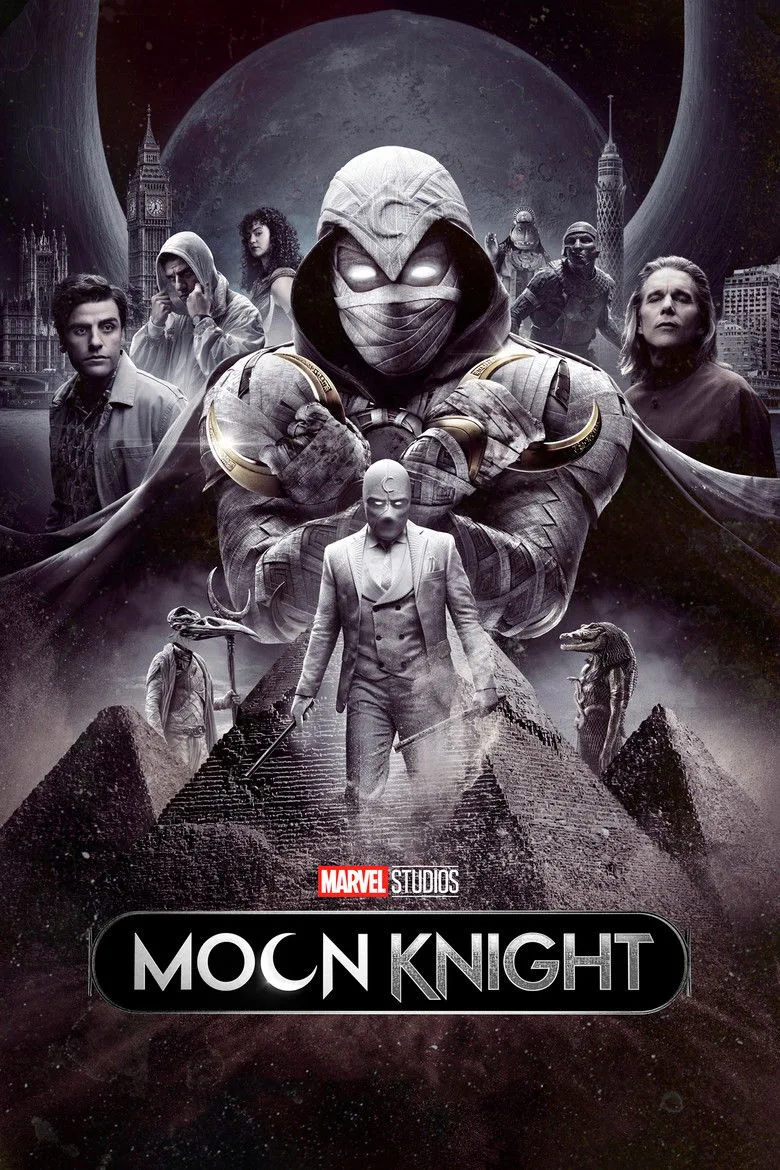
Why Did I Love This Film?
Moon Knight is not just another standard Marvel production. What sets it apart is its boldness in approaching the theme of a fragmented identity and dissociative identity disorder, presenting it through a visual style steeped in mystery and psychological unease. The story's hero is no classic protagonist who knows his role and performs it with confidence — he is a man lost in the dark, unable to tell where his own reality ends and where the other presence living within him begins. The ancient Egyptian mythology, gods who manifest in the modern world, and the struggle between two identities sharing a single body — all these elements combine to create a viewing experience that does not rely on excitement alone, but pushes the audience toward genuine questions about the nature of consciousness and the self. A rating of 7.646 out of 10 reflects an audience that found in this work something beyond the usual formula. If you are among those who enjoyed this experience, the following films share multiple threads with it: inner conflict, myths that break into reality, narrative ambiguity, and characters who carry psychological burdens heavier than any external enemy. ---1. Split (2016)
This film is the closest in mood and psychology to Moon Knight. It tells the story of a man suffering from dissociative identity disorder, inhabited by twenty-three different personalities competing for control over his body and mind. Director M. Night Shyamalan builds a mounting tension that does not stem from action sequences, but from within the protagonist's own fractured self. The parallel with Moon Knight is direct: a divided character, a fragile identity, and a constant question of who is truly holding the reins. This film suits those drawn more to the psychological dimension than the supernatural, and those who prefer the tension of a closed room over street battles. ---2. Doctor Strange (2016)
This film intersects with Moon Knight through the thread of a character who finds himself thrust into a world far larger than himself — a world filled with multiple dimensions and supernatural forces. The difference is that Doctor Strange's appeal lies in its striking visual spectacle and in the character's arc of transformation from arrogance to humility. Both works share the same question: how does a person cope with a power beyond their comprehension? It suits those who want science fiction and fantasy combined with dramatic depth in character building. ---3. Black Swan (2010)
One of the deepest cinematic studies of a fractured identity. A ballet dancer watches the boundaries dissolve between her true self and the character she performs on stage, until the two blur together in a deeply unsettling and painful way. Director Darren Aronofsky offers no easy answers, but leaves you in a state of uncertainty that closely mirrors what a viewer of Moon Knight feels during the protagonist's blackouts. This film is neither an action movie nor science fiction, yet it shares the same soul as Moon Knight: a man or woman who battles what is within more than what is without. It suits those who can handle psychologically intense and uncomfortable films. ---4. Unbreakable (2000)
From the same director as Split, this film offers an earlier and different perspective on the idea of a man who gradually discovers he carries something extraordinary within himself. The deliberate slowness and quietly constructed style make it the opposite of loud action films, yet at its core it poses the very same question Moon Knight poses: who am I, truly? And is the power I carry a gift or a curse? It suits those who value a slow pace and depth over surface-level excitement. ---5. The Mummy (1999)
The comparison may seem unexpected, but it is entirely logical. Ancient Egypt, gods and spirits returning to life, battles between ancient forces and modern heroes — these are elements shared between both works. Moon Knight takes this premise more seriously and infuses it with a psychological depth absent from The Mummy, but the spirit of adventure and the invocation of Egyptian mythology place the two films in the same imaginative territory. It suits those who love adventure set within an ancient Egyptian framework and do not mind a lighter level of dramatic complexity. ---6. Legion — The Series (2017–2019)
This FX production is also drawn from the Marvel universe, yet it heads in a direction entirely different from the rest of the company's output. David Haller is a man who spends years believing he suffers from a mental illness, only to discover he possesses immense superhuman powers he cannot control. The connecting thread with Moon Knight is unmistakable: the ambiguity between genuine mental illness and supernatural ability, a confused identity, and a narrative that deliberately misleads you. The series features distinctive cinematography and an experimental visual language. It suits those who can handle non-linear storytelling and enjoy blending fantasy with philosophical inquiry. ---7. Constantine (2005)
A character who moves between two worlds, sees what others cannot, and bears the burden of mediating between good and evil on a cosmic scale. John Constantine is not a hero who is happy in his role, and that is precisely what gives him real dramatic weight. The connection to Moon Knight runs through the idea of a man who was chosen — or compelled — to carry a role he does not entirely want, and through the dark atmosphere built upon mythology and supernatural forces. It suits those who enjoy religious fantasy and noir in equal measure. ---8. Shutter Island (2010)
Martin Scorsese's film takes the idea of an ambiguous identity and constructs it with meticulous precision all the way to its end. A federal marshal arrives at a psychiatric facility to investigate the disappearance of a patient, and gradually begins to doubt everything: reality, the people around him, and finally himself. The inverted ending is not merely a narrative trick, but a painful meditation on a person's choice of identity. This intersection with Moon Knight is deep and deliberate: a character who does not know where they stand in relation to their own reality is the heart of both works. It suits all lovers of psychological mystery films that leave a lasting impression long after the credits roll. ---In Summary
What unites all these works is not science fiction or action per se, but the courage to explore the human interior at its darkest and most complex. Moon Knight opened a door for viewers who want more from superhero stories than just exhilarating battles — who want characters that suffer, question, and lose their way before finding it again. This list is your guide to more of that journey.📝 This article is an editorial piece based on publicly available information about the film. The author's opinions do not necessarily represent the platform's position, and some details may differ from official sources.