

Films Similar to Mississippi Burning 1988 — A Curated List
Why I Loved This Film
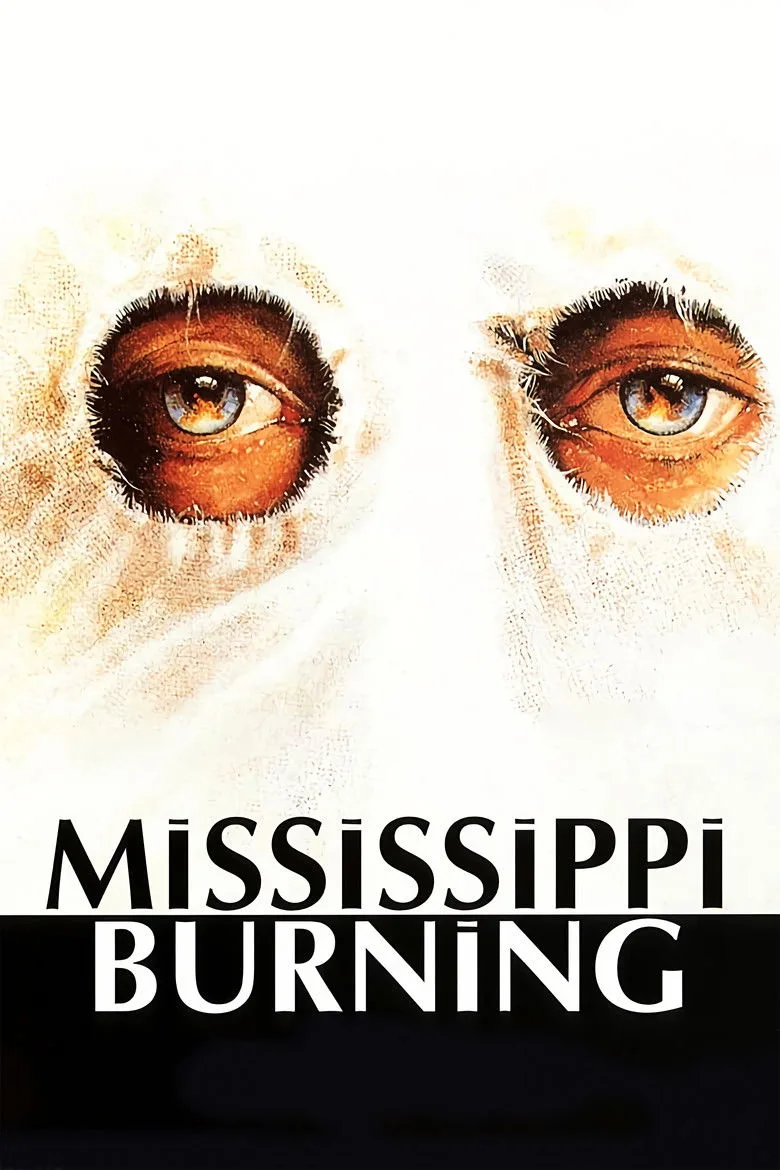
Mississippi Burning is not merely a police thriller hunting down criminals in a small town — it is a cinematic document that digs into one of America's deepest, still-unhealed wounds. The film takes you to the summer of 1964 in the heart of the American South, where the very air seems charged with hatred, fear, and complicit silence. What makes this work so distinctive is the constant tension between the two federal agents' contrasting approaches: one believes in the law and its institutions, while the other knows that those very institutions are sometimes part of the problem. The viewer does not simply feel like they are following a criminal case; they feel the full weight of an entire social order pressing down on every character in the film — the white woman who dares to speak, the Black man afraid to lift his head, the investigator who carries secrets from his own past in this very land. The rating the film carries reflects its true worth as a work that strikes a balance between crime thriller and social depth. If you are a fan of films that combine criminal suspense with sharp social critique and characters of complex human dimensions, the following list will make for an excellent companion. ---1. To Kill a Mockingbird — 1962
A film adapted from Harper Lee's celebrated novel, also set in the American South during the Great Depression. It follows the case of a Black man falsely accused of raping a white woman, whose defense is taken up by a courageous lawyer who must face the rage and racism of his own community. The reason for the similarity is clear: both films put you in direct confrontation with institutional racism in the American South, and both make you feel how an entire society can conspire in injustice. The performances are restrained, and the quiet, measured storytelling conceals a burning ember within. Best for: Those who want a film that examines justice from both a legal and a moral perspective, and not necessarily an action-driven thriller. ---2. In the Heat of the Night — 1967
This film is considered one of the closest works in spirit and style to Mississippi Burning. A brilliant Black detective from Philadelphia arrives in a small Mississippi town to investigate a murder, only to find himself in direct conflict with a white police chief who carries his own deeply ingrained prejudices. The similarity here is evident in the theme of the mismatched duo, the near-identical setting, and the closely overlapping era. The film won the Academy Award for Best Picture, and it deserves it for many reasons — chief among them the depth with which it handles the conflict between its two lead characters. Best for: Those who loved the dynamic between the two agents in Mississippi Burning and want to see a classic version of it from a different perspective. ---3. Selma — 2014
A film documenting the events of the Selma to Montgomery marches of 1965, one of the most defining moments of the American civil rights movement. It follows Dr. Martin Luther King Jr. and his colleagues as they face the organized violence awaiting them at every turn. What connects it to Mississippi Burning is the same era and the same struggle, but approached from the completely opposite angle. While the former examines the problem through the eyes of investigators arriving from outside, this film lives it from within the Black community fighting for its own freedom. Together, the two films give you the full picture. Best for: Those who want to complete their understanding of that era from a perspective more deeply rooted in the lives of those at the heart of the struggle. ---4. The Accused — 1988
Released around the same year, this film tackles a real-life rape case that became a legal battle over the very concept of justice and social complicity. A young woman finds herself facing a legal system that places her under suspicion rather than defending her. The similarity here lies in the theme of societal complicity — how a group of people can witness an injustice and choose silence or participation. The film confronts honestly the idea that the greater crime is sometimes not the act of the perpetrator alone, but the silence of everyone else. Best for: Those more interested in the social and legal dimensions of crime than in mystery and suspense. ---5. Prisoners — 2013
A contemporary thriller that raises profound questions about the limits of justice and what a person is capable of doing in order to obtain it. When two young girls disappear, a desperate father decides to take the law into his own hands while the detective on the case follows his own threads in his own way. The common ground with Mississippi Burning is that tension between two different methods of searching for the truth, and the lingering moral question of whether the ends justify the means. The film grabs you from the very first scene and never lets go. Best for: Those who want a high-quality thriller experience with psychological and moral depth, without needing a specific historical context. ---6. Detroit — 2017
This film takes you back to the riots that swept through Detroit in 1967, focusing specifically on a harrowing night at the Algiers Motel, when police officers detained a number of young Black men and subjected them to abuse that leaves the viewer with a genuine sense of anguish. The film does not shy away from brutality, nor does it sanitize it — and that is precisely what brings it close to the spirit of Mississippi Burning in its honest portrayal of state violence directed against specific communities. Director Kathryn Bigelow places you right at the center of that suffocating night. Best for: Those who can endure scenes of intense pressure and tension and want a film that stays with them long afterward. ---7. Just Mercy — 2019
Based on a true story about a young lawyer fighting to prove the innocence of a man on death row in Alabama. The film patiently traces how racism intersects with the judicial system to produce verdicts that have nothing to do with justice. What it shares with Mississippi Burning is that sense of frustration in the face of a system that appears designed to protect injustice rather than combat it — alongside a deeply human insistence on refusing to give up. The film is quiet in its approach, but its impact is cumulative and profound. Best for: Those who prefer films that build their tension slowly and methodically rather than through loud, dramatic scenes. ---8. BlacKkKlansman — 2018
Spike Lee's film, based on the true story of a Black police officer who successfully infiltrated the Ku Klux Klan in the 1970s. The film skillfully blends drama with dark satire to expose the glaring contradictions within American society. It shares with Mississippi Burning a direct engagement with the Ku Klux Klan as the central conflict, but does so from an entirely different angle and with a boldness that critiques the present just as sharply as it does the past. Best for: Those who want a film that balances historical weight with vibrant narrative energy, and who are not afraid of tension being mixed with moments of sheer astonishment. ---Conclusion
This list is not simply a collection of films revolving around racism in the American South — these are works that share with Mississippi Burning a single, timeless question: what happens when the institutions supposedly designed to protect justice become instruments for suppressing it? Each film on this list answers that question in a different way, and each one adds a new layer of understanding for those who wish to explore this kind of cinema more deeply.📝 This article is an editorial piece based on publicly available information about the film. The author's opinions do not necessarily represent the platform's position, and some details may differ from official sources.