

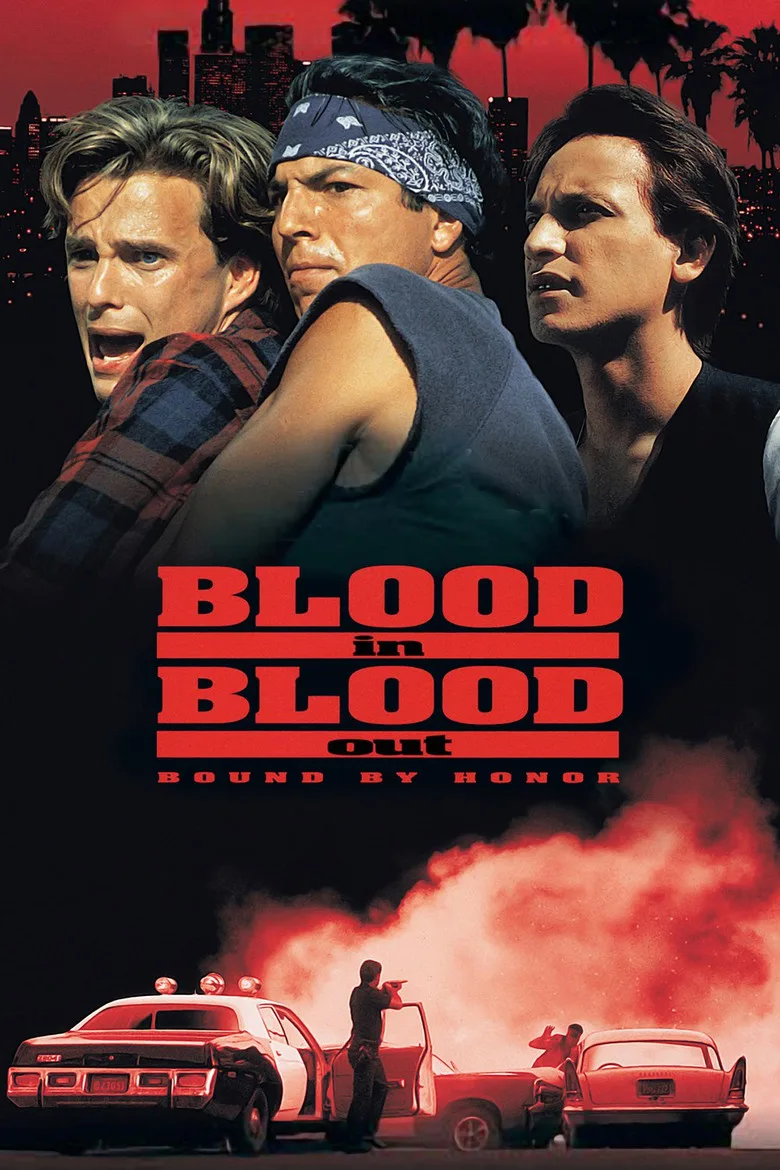
Most Notable Scenes from Bound by Honor 1993
Bound by Honor, the 1993 film directed by Taylor Hackford, stands as one of the most profound and honest works ever made about gang life in Los Angeles. Spanning two hours and forty minutes, the film traces the journeys of three young men bound by the same blood, whose lives splinter off in contradictory directions after a single crime turns everything upside down. Perhaps what distinguishes this film most is that it doesn't settle for narrating events from the outside — it dives into the fine human details that build a character and break one at the same time. Below is an overview of the most notable scenes that formed the film's backbone. ---Scene One: The Opening Tattoo Scene — An Identity Carved into Skin
The film opens with a tattoo scene that carries a meaning far deeper than its visual image. We see Miklo, one of the central characters, receiving a tattoo on his body as a mark of belonging to a street gang. This scene is not merely an introduction to the character — it is an explicit declaration of the bond that will govern his fate throughout the entire film. The camera slowly closes in on the needle as it etches into the skin, and the suppressed pain on the young man's face reflects not only the hurt of that moment, but hints at a greater pain yet to come. Director Hackford uses this scene to say plainly: belonging to the street is not a passing choice, but a permanent wound that never heals. The quiet music in the background lends the moment an almost ritualistic quality, as though the young man is swearing an oath from which there is no return. ---Scene Two: The Crime That Divides — A Night That Changes Three Fates
This is the pivotal scene that splits the film into before and after. When the crime occurs that sends Miklo to San Quentin prison, Hackford films the event with a degree of indirection in certain moments — the focus is not solely on the act itself, but on the faces of the three men the instant they grasp what has happened. Cruz stands in the middle of the road, his face a mixture of terror and helplessness; Paco freezes as though he has lost all capacity to act; and Miklo surrenders himself to the consequences of what has occurred with a heavy silence. The scene achieves what many loud action sequences cannot: it makes you feel the weight of the moment without raising its voice. The cold lighting and tight angles trap the characters within the frame, just as their choices will trap them within their lives. ---Scene Three: Inside San Quentin Prison — When Survival Becomes an Art
The prison scenes in this film merit their own dedicated discussion, but the most striking among them is the one in which Miklo discovers that prison is not merely a place to serve a sentence, but a permanent internal war zone. The scene in which Miklo faces a choice between joining a white supremacist gang or standing alone embodies the film's central moral dilemma: can you preserve your true identity when the world forces you to choose a tribe? Damian Chapa's performance in this particular scene is marked by a striking self-restraint — his anger is suppressed, his calculations are visible on his face, and his silence is more painful than any words. The director holds the camera on his face for a long time, trusting that this face alone can carry everything he wants to say. ---Scene Four: Cruz and the Paintbrush — Talent Drowning in the Mud
In one of the film's most painful scenes, we see Cruz attempting to paint in a room that mirrors the chaos living inside him. The young man who once possessed genuine artistic talent has become a prisoner of drugs, which devour his time, his energy, and his creativity. The scene depicts a moment in which he picks up the paintbrush and then sets it down, begins a painting and then leaves it unfinished. This repeated stopping is not laziness — it is the portrait of a man trying to grasp something he can see and knows, but cannot reach. The close-up shots of his trembling hands and glazed eyes say what no dialogue could: this is a man dying slowly within his own life. The film neither demonizes Cruz nor excuses his actions, but shows you how a person can be both victim and executioner of himself at the same time. ---Scene Five: The Final Confrontation Between Brothers — Blood Is Not Enough
The film's ending carries a scene that brings the two brothers face to face in a confrontation that summarizes everything that came before. Paco, who has become a police officer, stands before Miklo in a situation not so different from that first night that tore them apart — yet the roles have grown far more complicated and the wounds run far deeper. The dialogue in this scene is deliberately sparse; the sentences are short, the silences long, and the camera moves between their two faces searching for the remnants of the brotherhood that once was. What makes this scene linger in the memory is that it offers no easy answers and no comfortable resolutions. The film ends its story the way it began: with questions rather than certainties, with an open wound rather than a closed scar. ---Conclusion
What makes these scenes embed themselves in the viewer's consciousness long after the film ends is that they do not chase surface-level spectacle — they accumulate meaning layer upon layer. Hackford built a film that trusts in the power of image and silence to speak, and gave his actors the full space to express themselves through their bodies and their faces before their mouths. Bound by Honor remains one of the most honest works ever made about the steep price a person pays when the street binds him from one side and blood binds him from the other, without anyone ever offering him a key to get out.📝 This article is an editorial piece based on publicly available information about the film. The author's opinions do not necessarily represent the platform's position, and some details may differ from official sources.