

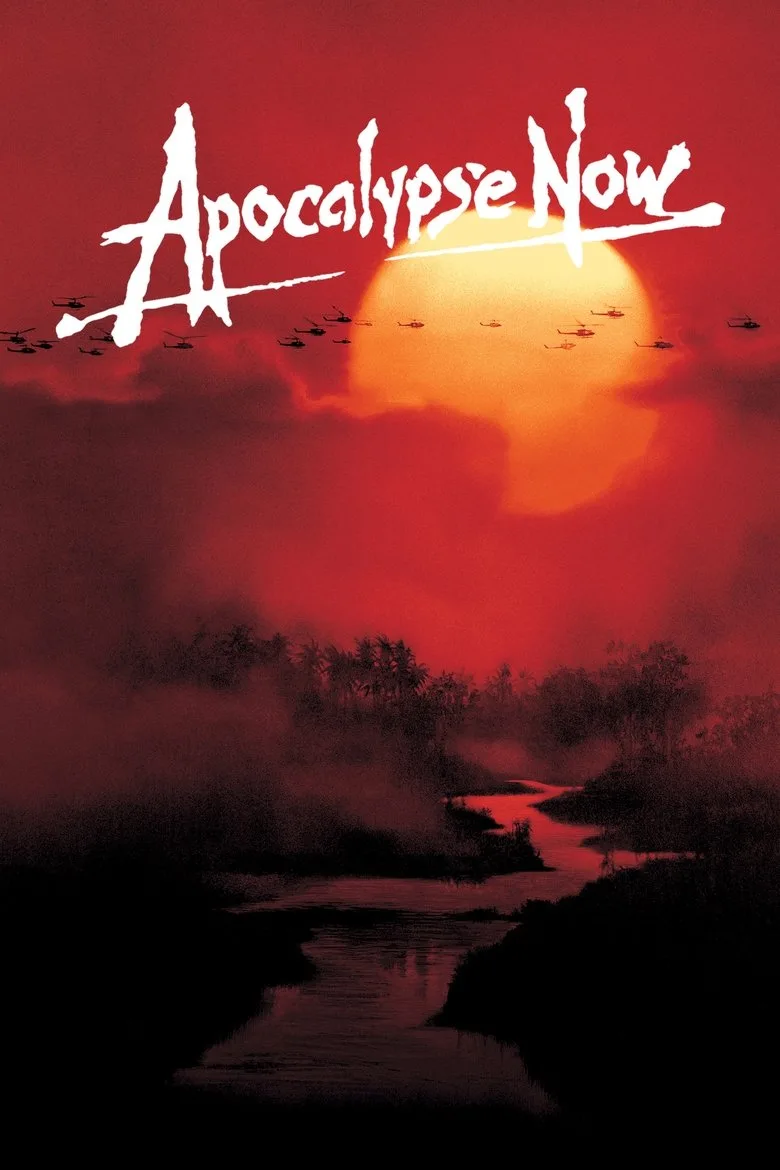
The Most Iconic Scenes of Apocalypse Now 1979
Apocalypse Now remains one of the most influential films in the history of American cinema — not because it depicts war in a literal military sense, but because it plunges deep into what war does to a person from the inside. Directed by Francis Ford Coppola in 1979, the film drew its world from Joseph Conrad's novella "Heart of Darkness," transporting it to the jungles of Vietnam to become one of the most harrowing and profound cinematic experiences ever made. The scenes this film contains are not merely dramatic moments; they are waypoints on a journey of the human soul's gradual disintegration. ---Scene One: The Room and the Helicopter — The Unforgettable Opening
The film opens on the face of Captain Willard, lying in a hotel room in Saigon, drowning in alcohol and memories. The sound of helicopter blades morphs into the sound of ceiling fans, and the line between reality and hallucination slowly dissolves. Willard moves erratically in front of a mirror, shatters it with his hand, and sinks to the floor as blood streams from his palms. This scene was not purely a performance; actor Martin Sheen was genuinely drunk during filming, and the breaking of the mirror was not scripted. Coppola chose to keep everything. The result was a raw moment unlike any other opening scene. The music — "The End" by The Doors — drifts through the background like an early elegy, while images of burning jungle are superimposed over Willard's face in a visual layering that tells us: this man never left the war, and the war never left him. ---Scene Two: The Helicopter Attack — War as Music
When the helicopters of the First Air Cavalry, led by Colonel Kilgore, sweep toward a Vietnamese coastal village, Kilgore orders Wagner's "Ride of the Valkyries" blasted through loudspeakers mounted on the aircraft. The sound fills the sky, rockets pour down, the village burns, and Kilgore appears in a state of complete euphoria. This scene does something deliberate and dangerous: it makes destruction visually seductive. Coppola implicates you, as a viewer, in the thrill of the spectacle before you fully register what you are actually watching. Shots of fleeing children, burning buildings, and bodies — they are all there — but the music and the camera's movement push you toward awe. This is the film's true commentary on the nature of war: that it manufactures its own false beauty, one that numbs the conscience. Kilgore's famous line arrives later in this same context: "I love the smell of napalm in the morning… It smells like victory." No remorse, no questioning — only a strange pleasure found in destruction. ---Scene Three: The Playmate Show — A Party in the Dark
Midway through Willard's journey up the river, the boat's crew arrives at a military supply post that has transformed into something resembling an American consumer nightmare dropped in the middle of the jungle. A show is held for Playboy Playmates; soldiers crowd together by the thousands, and chaos reigns. When the girls take the stage, the event descends into unbearable pandemonium and ends with the area being evacuated amid the uproar. What makes this scene so striking is not what happens in it, but what it means. This is America's attempt to preserve the image of normal life in the middle of a meaningless hell. Thousands of soldiers in one place, not knowing why they are fighting, searching for a moment of forgetting in the heart of the jungle. Willard's face watches it all with the eyes of a man who sees the collapse but can do nothing to stop it. ---Scene Four: The Slaughter of the Ox — Ritual and Killing
When Willard finally reaches Kurtz's compound, shots of an ox being slaughtered in a tribal ritual are intercut with shots of Willard killing the Colonel with a machete. This parallel montage is among the most debated and interpreted sequences in the history of cinema. Coppola draws an equivalence between two acts: the ceremonial slaughter of an animal in a religious rite, and the killing of a man on a military mission. Who is the victim? Who is the one making the sacrifice? What is the difference between a primitive ritual and a military order? The answer the film proposes is deeply unsettling: perhaps there is no fundamental difference. Kurtz himself chose to face his fate without resistance, as though he too were performing his own ritual — a surrender to death. The actual slaughter of the ox was not staged; it was filmed during a real ceremony conducted by the local inhabitants, adding a layer of raw truth that no visual effects could replicate. ---Scene Five: Kurtz's Monologue — The Horror and the Truth
In one of the film's most visually quiet yet most violently charged passages, Colonel Kurtz sits in darkness and recounts a story to Willard: when he was an officer who believed in the American mission, he came with his unit to a village and vaccinated the children against polio. Afterward, Vietnamese fighters returned and cut off the arm of every child who had been vaccinated. Kurtz recalls weeping at the time, then later coming to understand that this kind of iron will is precisely what it takes to win. Marlon Brando delivers this scene in a low, trembling voice, half his face lost in shadow. No music, no dramatic camera movement. Only words that bore in slowly. Kurtz is not defending cruelty; he is describing it as a truth he discovered in the depths of war and could never un-know. His most famous line encapsulates his broken philosophy: "Horror and moral judgment must be friends." This scene poses the central question of the entire film: if war produces this kind of poisoned wisdom, what is left of the human being in the end? ---Conclusion
What binds these five scenes together is not plot, but condition. Apocalypse Now is not a film about who wins and who loses; it is about what war reveals in a person once every social covering has been stripped away. Coppola offers no comfortable answers and no clean heroes. He places you in front of the mirror and asks: how far will you go before you stop recognizing yourself?📝 This article is an editorial piece based on publicly available information about the film. The author's opinions do not necessarily represent the platform's position, and some details may differ from official sources.