

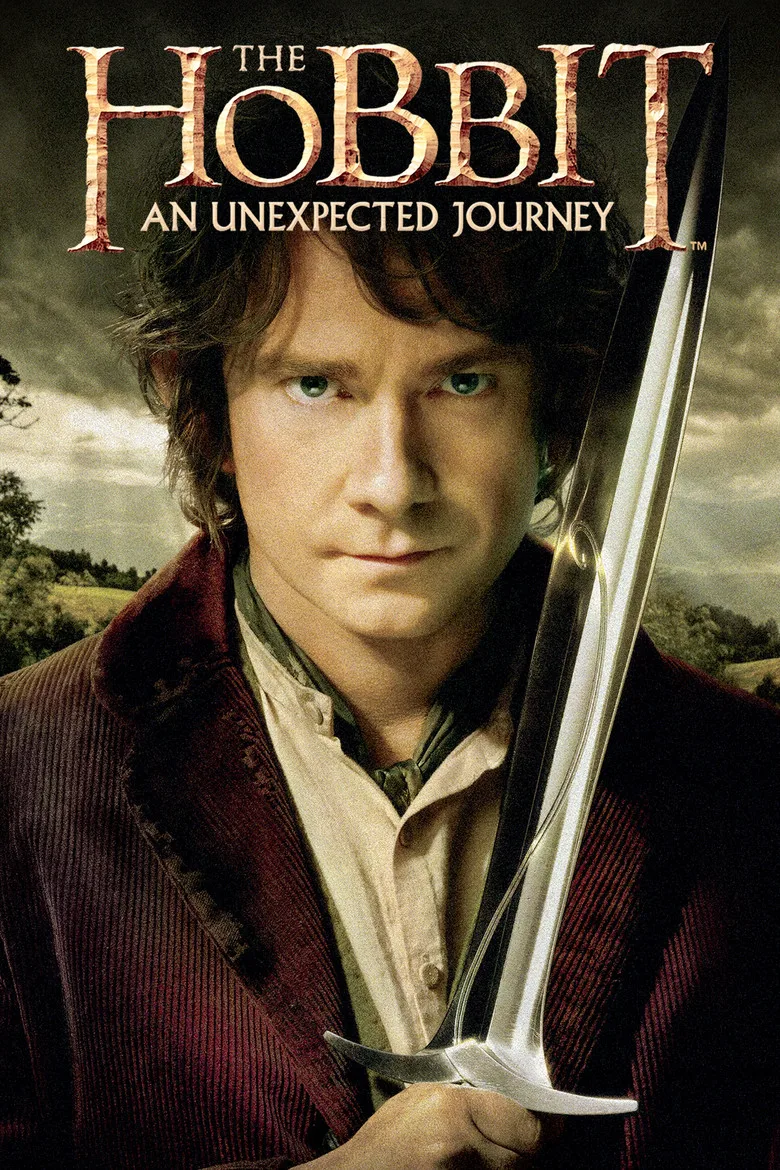
Review: The Hobbit: An Unexpected Journey (2012)
New Zealand director Peter Jackson returned to the world of Middle-earth roughly a decade after completing his landmark Lord of the Rings trilogy, this time bringing J.R.R. Tolkien's shorter and simpler novel to the screen in a lavish three-part production. The Hobbit: An Unexpected Journey is the first installment of that trilogy, released in 2012 to wide commercial success — yet commercial success alone does not necessarily equal artistic achievement, and that distinction is at the heart of what we will discuss in this article. ---The Story
The film follows Bilbo Baggins, a quiet hobbit living comfortably in his home in the Shire, far removed from any adventure or risk. But a visit from the wizard Gandalf the Grey, accompanied by thirteen dwarves led by Thorin Oakenshield, turns his life upside down. Bilbo is tasked with an unexpected mission: to accompany the dwarves on their quest to reclaim the kingdom of Erebor from the dragon Smaug. On the narrative level, the film suffers from a fundamental problem of pacing. Tolkien's original novel is a text aimed at children that can be read in a day or two, and stretching it across three films each exceeding two and a half hours demands a considerable amount of additional padding. Jackson draws on material from Tolkien's appendices and other writings beyond the novel itself, which lends the first installment a somewhat scattered quality at times — you sense that certain scenes were added to fill time rather than to serve the plot. That said, the film remains broadly enjoyable, and particular moments do succeed in generating genuine interest, most notably the riddle scene between Bilbo and Gollum, which stands as one of the film's tensest and most tightly crafted sequences. ---Performances
Martin Freeman delivers a standout performance as Bilbo Baggins, embodying the ordinary man who finds himself far outside his comfort zone with remarkable precision. His facial expressions and natural reactions lend the film a degree of authenticity amid a world saturated with visual excess. Freeman excels in moments of confusion and hesitation, making the audience empathize with Bilbo without the need for rousing speeches or grand gestures. Ian McKellen, by contrast, reprises his role as Gandalf in exactly the same manner we knew from The Lord of the Rings, which provides a degree of familiarity but adds nothing new. Richard Armitage as Thorin plays the character with acceptable gravity and weight, though at times the film seems to be trying to fashion him into "another Aragorn" without granting him sufficient depth in this installment. The thirteen dwarves form a human mass that is difficult to distinguish between in many instances — a genuine problem that causes viewers to attach to some of them and not others. Andy Serkis's performance as Gollum deserves special mention; his ability to convey the character's profound internal psychological contradictions through motion-capture performance and dialogue remains one of the most powerful elements of this cinematic universe. ---Direction and Cinematography
Jackson chose to shoot the film at 48 frames per second rather than the standard 24, a controversial decision that divided audiences sharply. The visual result gives the image an excessive clarity that makes it look, at times, closer to a high-quality television series than a cinematically atmospheric feature film. This technical approach, however innovative, damaged the dreamlike aesthetic quality that had distinguished The Lord of the Rings trilogy. In terms of overall direction, Jackson maintains firm control over the large-scale crowd scenes and battles, demonstrating a clear ability to manage expansive visual spaces. However, he occasionally overextends chase sequences and battle scenes well beyond their dramatic necessity. The battle between the dwarves and the goblins in the mountains is a clear example of this excess in action that loses its meaning when drawn out for far too long. The production design and visual effects remain among the film's most rigorous and professional elements; Middle-earth is constructed with evident precision and care, and the natural landscapes of New Zealand lend the film an undeniable visual beauty. Howard Shore's score revisits the familiar melodic themes from the previous trilogy, which will satisfy fans but offers no new musical vision specifically tailored to this film. ---Strengths and Weaknesses
Strengths Martin Freeman's performance: He gives the film its human heart and allows the audience to follow the journey through a character they can genuinely empathize with. The riddle scene with Gollum: It remains the single best sequence in the film, in terms of dramatic tension, the intelligence of its writing, and the quality of its performances. The visual design of the world: The architectural and geographical details of Middle-earth reflect a clear creative effort that cannot be denied. Positive nostalgia: For viewers who loved The Lord of the Rings trilogy, the film offers a welcome dose of familiarity with this beloved world. Weaknesses Excessive length: The film's runtime of over 169 minutes is disproportionate to the amount of narrative material available in the first portion of the novel, resulting in a recurring sense of padding. The 48-frames-per-second decision: It damaged the film's traditional visual aesthetics and made it look disconcertingly different from its predecessors. Weak character differentiation: The thirteen dwarves receive insufficient development in this installment, leaving most of them as similar-looking faces without notable depth. Slow opening: The first third of the film is marked by considerable slowness that may test the patience of viewers who are not accustomed to this genre. ---Final Verdict
The Hobbit: An Unexpected Journey is a film that carries within it a clear contradiction: it is simultaneously an enjoyable film and an unnecessarily bloated one. Peter Jackson is a talented filmmaker who knows how to build fully realized visual worlds, but in this project he fell into the trap of excess, choosing spectacle over the poetry that had distinguished his first trilogy. Compared to The Lord of the Rings: The Fellowship of the Ring, The Hobbit: An Unexpected Journey feels less nimble and less profound in its exploration of human themes. The original novel carried the spirit of a coming-of-age story and self-discovery, a dimension that does appear in the film but with less impact than it could have had if the story had been given room to breathe rather than simply room to expand. The film's overall rating of 7.4/10 seems largely fair; it is an acceptable work that entertains and engages, but it does not rise to the level of expectations set by the preceding trilogy. If you are a fan of Tolkien's world, you will find enough here for an enjoyable viewing experience; but if you are seeking a cinematic experience that leaves you in deep reflection, you may not find exactly what you are looking for here. ---📝 This article is an editorial piece based on publicly available information about the film. The author's opinions do not necessarily represent the platform's position, and details may differ from official sources.