

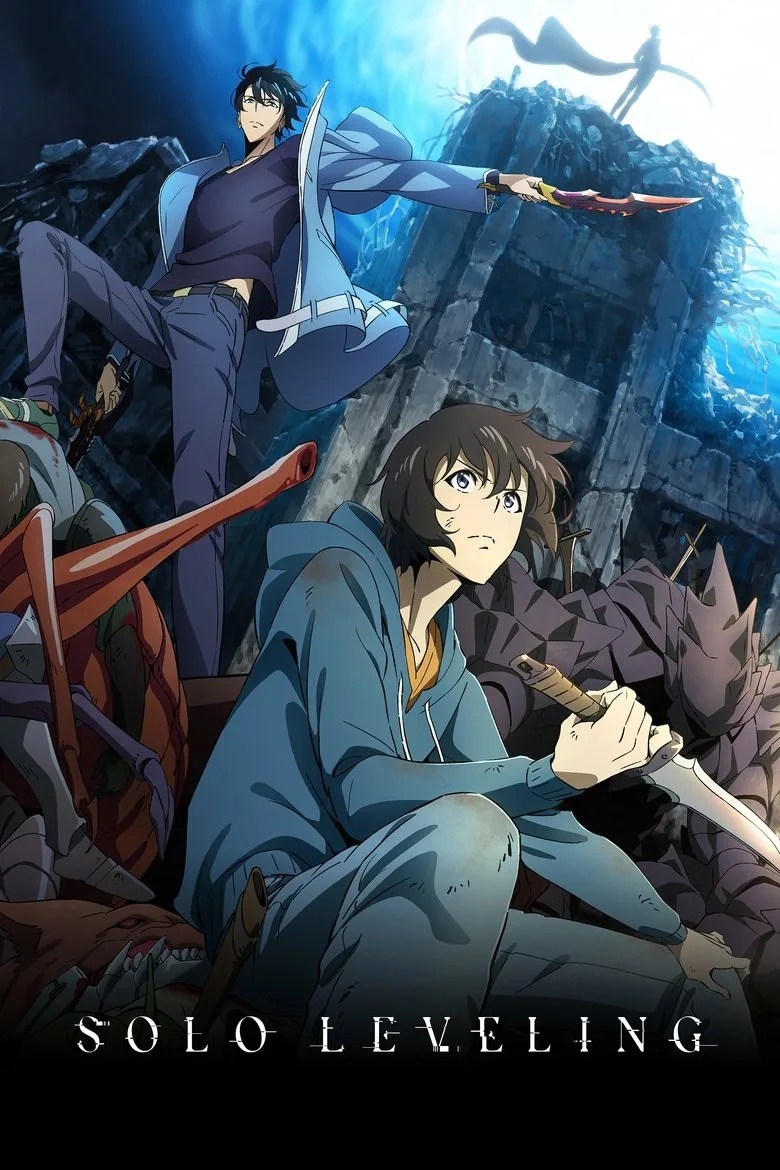
When fans of manga and Korean manhwa discuss series that deserved an anime adaptation, Solo Leveling always tops the list. The announcement of an anime production for this work generated enormous excitement — yet excitement alone is not a sufficient measure of quality, as there is often a wide gap between expectations and what actually appears on screen. In this review, we examine the first season of this Japanese anime produced in 2024, through a critical lens that prioritizes objectivity over emotional bias.
Series Story
Solo Leveling takes place in a world where "Gates" have appeared — dimensional rifts that lead to dungeons filled with dangerous monsters. In response to this threat, a class of humans known as "Hunters" emerged, possessing extraordinary abilities that allow them to enter these dungeons and clear them out. Yet our protagonist, Sung Jinwoo, sits at the very bottom of this hierarchy: a Hunter of the weakest rank, risking his life on marginal missions simply to cover his mother's medical bills. The pivotal turning point comes when Jinwoo finds himself trapped inside a "Double Dungeon" — a rare and lethal type of dungeon — and on the brink of death, a "Quest Window" invisible to everyone else appears before him, presenting him with a new challenge to accept, and thus begins his unique journey of growth.
The screenplay is based on the acclaimed Korean manhwa by author Chugong, and the adapters have succeeded in preserving the core dramatic arc without falling into the trap of disruptive filler. However, one objective observation is worth making: the events in the first half of the season unfold at a relatively leisurely pace, and viewers unfamiliar with the source material may sense some sluggishness before the excitement accelerates in the second half. Additionally, the narrative world remains underdeveloped in terms of exploring the root causes behind the appearance of the Gates, as the work concerns itself more with consequences than origins.
Voice Acting and Characters
The task of voicing Jinwoo was entrusted to voice actor Tarusuke Kobayashi, who delivered a clearly competent performance, balancing the character's outward coldness with the determination and suppressed pride simmering within. Jinwoo is not a loud, emotionally expressive hero, which makes Kobayashi's casting a fitting choice — he communicates through silence as often as through words. As for the supporting characters such as Yoo Jinho and Choi Jongin, they received acceptable voice performances without amounting to any notable dramatic weight in this first season, leaving them as little more than backdrop to the protagonist's journey for most of the time.
One of the most prominent weaknesses in character construction is that the antagonists and secondary characters lack sufficient depth — they are largely functional, serving the plot without acquiring an independent identity that might stir the viewer's curiosity about their full motivations.
Direction, Cinematography, and Animation
A-1 Pictures handled the production, a studio with an impressive track record that includes a number of distinguished works. It must be said that the animation quality varies throughout the season: the action sequences stand out noticeably and clearly receive the creative team's primary attention, with dynamic movement, diverse virtual camera angles, and dazzling lighting effects in the shadow-summoning scenes. By contrast, some ordinary dialogue scenes appear less carefully rendered in terms of visual detail, creating a noticeable inconsistency in image quality from one segment to the next.
As for the visual design of the dungeons and monsters, it is among the most distinctive features of this work, presenting striking environments ranging from eerie ancient ruins to terrifying caverns, lending an aesthetic variety that refreshes the viewer's interest. The score was composed by Hiroyuki Sawano, known for landmark works such as Attack on Titan, and it lends an intensely dramatic tone to the major confrontation scenes — though it occasionally feels larger in scale than the moment it accompanies.
Strengths and Weaknesses
Strengths
- Central character development: Jinwoo's progression from weakness to strength follows a relatively convincing logic, giving the viewer a genuine reason to keep watching.
- The gamification system: The concept of the "Quest Window" and the leveling-up mechanic give the narrative the feel of an interactive video game, a concept that resonates widely with younger audiences.
- Battle sequences: It is undeniable that some of the major confrontations constitute visually polished moments, particularly in the final episodes of the season.
- High audience rating: The series earned a score of 8.66/10, a figure that points to a broad and positive audience reception that cannot be overlooked.
Weaknesses
- Neglected secondary characters: The work suffers from a clear shortcoming in developing its supporting cast, making the world feel as though it was designed for one person alone.
- Unanswered cosmic questions: The first season does not provide sufficient answers about the nature and origin of the Gates, which may frustrate viewers seeking a complete and self-contained narrative.
- Inconsistent animation quality: The disparity between the quality of the action scenes and the ordinary scenes is noticeable to an attentive viewer's eye.
- Uneven pacing: Some episodes lack balance in their dramatic rhythm, making the weekly viewing experience inconsistent.
Final Verdict
Solo Leveling in its first season delivers a work that competently satisfies the needs of its specific audience without rising to the level of productions that redefine what anime can offer artistically. It is a series that makes good use of its popular source material, presenting it in a strong visual package during its most prominent scenes, yet it suffers from a "single hero" complex that narrows the scope of the storytelling, and from a world-building approach that defers its deeper development to future seasons.
For those looking for an action anime that provides viewing pleasure without demanding heavy intellectual engagement, this series is well worth the time invested. For those expecting complete narrative construction and a mature handling of the bigger questions, the first season will feel like a promising starting point that still needs time to fulfill its potential. The audience rating of 8.66 reflects a genuine commercial and popular success, which makes watching the second season a true test of the production team's ability to elevate the work from crowd-pleasing entertainment to genuine artistic distinction.
📝 This article is an editorial piece based on publicly available information about the series. The author's opinions do not necessarily represent the platform's position, and details may differ from official sources.