

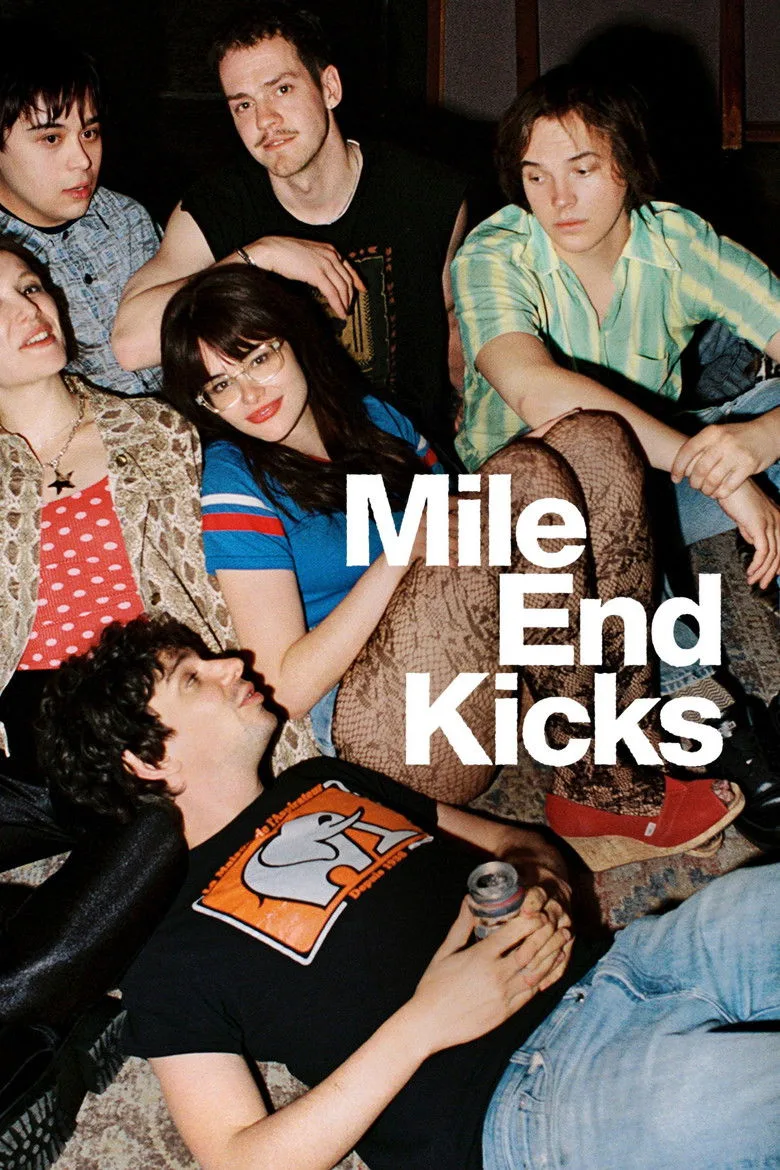
Mile End Kicks 2026 Review
Mile End Kicks arrives at a time when the romantic musical comedy genre is suffering from obvious saturation in the cinematic landscape, which means any new addition to this genre faces a double challenge: proving its worth against comparison with established works, and offering something genuinely worth watching. The film does not succeed at all of this completely, but it carries within it honest moments that prevent it from falling into the trap of being quickly forgotten. ---The Story
The film follows Grace, an ambitious music critic who decides to sever her ties with her old city and move to a new one, seeking to finally accomplish her long-deferred dream of literary writing. But what was supposed to be an isolated intellectual project gradually transforms into a sprawling life experience, when she collides with a rising band she had intended to write about from a safe professional distance. The idea at its core is not new; the theme of the journalist or critic who slips from the role of observer into the role of participant exists in numerous works. What the film attempts to offer is an additional layer in the form of a love triangle between Grace and two members of the band, alongside her new role as their unofficial public relations manager. This branching of roles lends the main character a degree of complexity, but at the same time it burdens the narrative with threads that the film cannot always manage efficiently. The screenplay moves at an acceptable pace in its first half, introducing the band's world and surroundings with light touches and dialogue that carries a natural quality. But as the emotional and professional complications escalate, the film resorts to familiar dramatic solutions and somewhat contrived turns, as though crises are resolved at a speed that does not match the weight assigned to them. The ending, while warm, feels as though it chose the easier path at the expense of the emotional logic upon which the film built its tensions. ---Performances
The acting represents one of the film's most stable pillars. The actress portraying Grace delivers a character who moves along a fine line between inner fragility and a composed external presence — something that requires a precision of expression not every actress can master. There are moments where the character feels entirely convincing, particularly in scenes of hesitation and self-reflection. As for the two band members who form the two sides of the love triangle, they deliver uneven performances; one has a natural screen presence that makes him convincing without visible effort, while the other appears less deeply embedded in his role, which weakens the emotional balance the triangle needs to be dramatically effective. The secondary characters among the other band members bring energy to the ensemble scenes, yet remain largely flat without any real depth. ---Direction and Cinematography
On the visual front, the director adopts an approach suited to the nature of the story: a handheld camera in the musical scenes that suggests the spontaneity and live energy of rising bands, contrasted with quieter, more contemplative shots in the intimate scenes. This visual variety works in the film's favor for the most part, though some of the concert scenes appear more polished than they should for a band that has not yet reached full fame. The new city where Grace settles receives notable visual attention; the streets, cafés, and enclosed spaces form a living backdrop that pulses with a particular energy reflecting the main character's state between belonging and estrangement. This intelligent use of place as a dramatic element is among the most mature directorial choices in the film. The music, which is a fundamental pillar in any musical film, arrived on two levels: the band's original songs are acceptable and create sufficient emotional impact without being genuine sonic experiences, while the score performs its function competently without leaving any notable independent impression. ---Strengths and Weaknesses
Strengths- The Main Character: Grace is a consciously written character who carries her inner contradictions with relative honesty.
- Balance Between Comedy and Drama: The film does not overplay the comedy to the point of draining the drama of its weight, nor does it lean so heavily into drama that it sacrifices the lightness it promises.
- Live Musical Scenes: They give the film a vital rhythm that refreshes it across several passages.
- Spatial Cinematography: The use of the city as an actual dramatic element rather than mere backdrop.
- The Unbalanced Love Triangle: One of its two sides is weaker in presence, which diminishes the real emotional conflict.
- Quick Dramatic Resolutions: Some crises are resolved with an ease that disrupts the story's internal logic.
- Flat Secondary Characters: The other band members remain within the circle of functional roles without depth.
- The Comfortable Ending: Choosing the warm conclusion at the expense of the complexity the film built creates a sense of incompleteness.
- Familiar Theme: The core idea does not offer a fresh enough perspective to stand out in an overcrowded landscape.
Final Verdict
Mile End Kicks is a film that sits comfortably in the middle ground between good and average. It is not a film that openly disappoints its audience, but it also does not give them anything to remember a week later. It suits the viewer looking for light, intelligent entertainment within a vibrant musical setting, provided they accept in advance that no deep narrative or emotional surprises are coming. The film's true value lies in its lead performance and in its quieter moments, which reveal a genuine sensitivity toward the subject of creativity and the fear of failure. Had that sensitivity been deployed with greater boldness in the screenplay, we would be looking at a different film altogether. But as it stands, Mile End Kicks remains a viewing experience that is both pleasant and perishable at the same time. Rating: 6 out of 10 ---📝 This article is an editorial piece based on publicly available information about the film. The author's opinions do not necessarily represent the platform's position, and details may differ from official sources.