

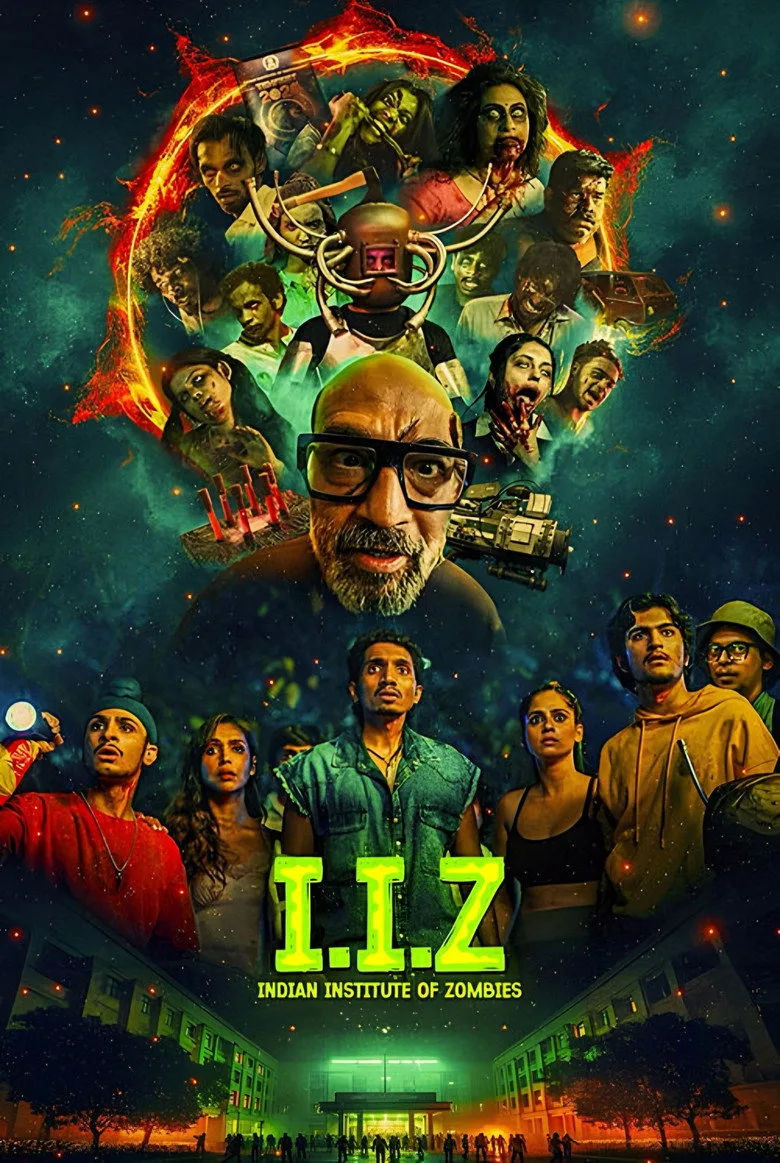
Indian Institute of Zombies 2026 Review
In an Indian cinema landscape that is growing increasingly bold in experimenting with unfamiliar genres, Indian Institute of Zombies arrives as an attempt to absorb more than one idea at once: a horror film, a dark comedy, and a social critique of India's elite education system. The concept itself is worth pausing over, since mainstream Indian cinema rarely attempts to use the zombie as a satirical tool for dissecting the tense academic reality. Yet the fundamental difference in cinema has always been the gap between the idea and its execution, and this film is no exception to that equation.
The Story
The film's events unfold inside an elite university campus that clearly references India's major technical institutes, where students live under the crushing weight of exams, academic rankings, and accumulated social pressure. Suddenly, a mysterious outbreak erupts, turning some students into zombie creatures, and the survivors find themselves confronting a new question: does survival demand the solidarity they never knew, or the competitive mindset they were raised on?
The film builds its central idea on an obvious paradox: students who had been competing over grades and standings suddenly find themselves in need of one another when facing a greater threat. This paradox is not new to world cinema — works such as Shaun of the Dead and Train to Busan have employed it in different ways — yet the film adds a clear local touch relating to IIT culture and India's grueling examination system. The problem is that the screenplay establishes this idea in the first quarter of the film and then repeats itself without adding new dimensions, leaving the viewer feeling they have understood everything the film wants to say long before it ends.
The plot structure suffers from visible sagging in the second act, where scenes pile up without delivering any real escalation of tension. Several dramatic threads are also introduced and then abandoned, such as the relationship between one of the professors and the students, which could have added a deeper critical layer.
Performances
One aspect that can be noted with relative positivity is the performance of some of the young actors, who carry the comedic scenes with genuine energy. The internal tension embodied by the lead actor — between his desire to survive and his clinging to a competitive mindset — is rendered with a degree of honesty, even if his character's dramatic arc lacks sufficient development.
In contrast, some of the supporting characters feel excessively flat, as though they represent stock types rather than real people: the grade-obsessed student, the rebellious girl, the ambitious student from a poor background. These archetypes can work in dark comedy when handled with skill, but here they come across as mere instruments for delivering the film's message directly, without the effort of dramatic illusion.
The actors' performances in the horror scenes vary considerably; some reactions feel convincing, while other scenes slide into overacting that pulls the viewer out of the overall atmosphere rather than deepening their sense of danger.
Direction and Cinematography
On the visual level, the film demonstrates an awareness of the campus's aesthetics and how to exploit its spaces: the vast libraries, the examination halls, the long corridors. This environment grants the film a distinctive visual identity that sets it apart from conventional zombie films, which typically rely on abandoned areas or hospitals.
However, the direction suffers from inconsistency in managing the balance between comedy and horror. The comedic scenes generally work at a good pace, but the moments of genuine horror arrive with weak impact, partly due to a visual approach that fails to build tension gradually. The director appears to have been far more at ease handling the comedy than crafting actual horror sequences.
The score performs its role in the satirical scenes, but resorts to familiar and predictable solutions during confrontation moments, which diminishes its emotional effect on the viewer.
Strengths and Weaknesses
The film earns credit for the boldness of its subject matter and its commitment to critiquing India's competitive education system, which has long been accused of destroying the mental health of young people. The film addresses this reality in a language that jokes when it needs to joke, and turns serious when it needs to be serious, and these difficult balancing acts sometimes succeed.
Likewise, several of the comedic scenes carry moments of sharp wit, particularly when it comes to the professors and university administration, who appear preoccupied with the institution's reputation even in the midst of catastrophe. This kind of satire hits its mark.
On the other hand, the film falls into the trap of tedious repetition at its midpoint. The critical message is stated once, twice, and three times in the same manner, until it loses its initial force. The screenplay is in need of deeper revision to avoid this sagging. Furthermore, the visual effects applied to the zombies appear limited in capability in certain scenes, affecting the credibility of the visible threat.
The ending is perhaps the film's greatest failure: the story concludes on an artificially optimistic note that contradicts the critical spirit the work had built throughout its runtime, as though the filmmakers hesitated at the last moment between standing by their critical stance or offering the wider audience a comfortable ending.
Final Verdict
Indian Institute of Zombies is a film that deserves to be watched for its concept, which raises genuine questions about the price of academic ambition in societies that worship certificates and marginalise mental health. However, the execution does not measure up to the ambition of the idea; the screenplay lacks coherence in its second act, the direction is uneven in managing the two cinematic genres, and the characters need far more depth than they were afforded.
The film is not an outright failure, but it represents a missed opportunity for a work that could have been far bolder and more profound. For those who enjoy dark comedies with a local flavor, it may offer a measure of entertainment with moderate expectations. Those seeking a genuine horror experience or a tightly constructed social critique, however, will find themselves facing a disappointment that cannot be overlooked.
Rating: 0/10 — a score that reflects the vast distance between what the film promised and what it actually delivered on screen.
📝 This article is an editorial piece based on publicly available information about the film. The author's views do not necessarily represent the platform's position, and details may differ from official sources.