

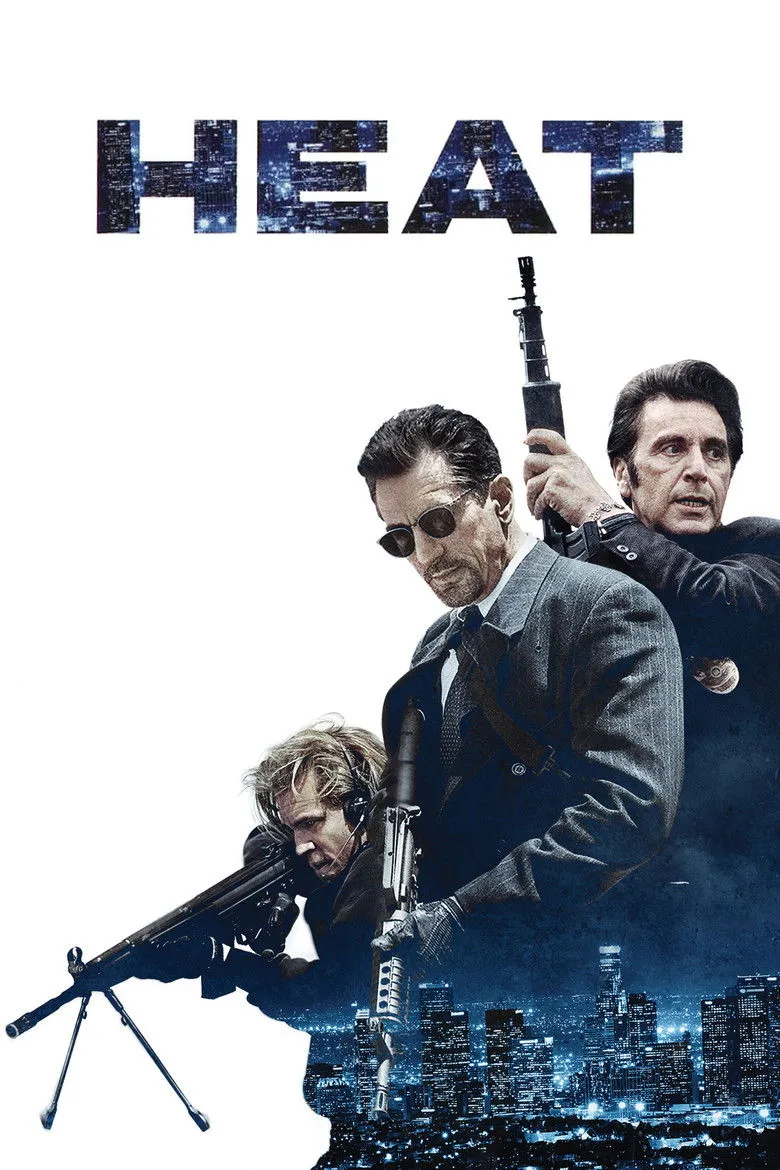
When cinephiles mention Heat, the mind immediately conjures that iconic café scene, where two titans of acting sit face to face in the quietest yet most charged confrontation in the history of crime films. Released in 1995 and directed by Michael Mann, this is a work that deserves serious study rather than passing praise, for it carries enough virtues to make it a benchmark of its genre, and enough flaws to keep it from reaching the perfection it reaches for.
---The Story
Heat unfolds across the Los Angeles of the nineties, where director Michael Mann draws two parallel lines for two characters fated to collide. Vincent Hanna (Al Pacino) is a detective burning from the inside, sacrificing his personal life on the altar of his profession, every marriage he builds crumbling under the weight of his obsession with work. On the other side, Robert De Niro plays Neil McCauley, a professional thief who operates with a surgeon's precision, who has condemned himself to solitude and perpetual movement, and who lives by a single principle: never be attached to anything you cannot walk away from in thirty seconds.
The screenplay, written by Mann himself, is built on his 1989 television film L.A. Takedown. The dramatic equation is clear and direct: the criminal and the cop are two sides of the same coin, living the same loneliness and paying the same price. This idea is not new to crime literature, but Mann executes it with human detail that gives it a different kind of weight. That said, the subplot involving the detective's teenage daughter suffers from a noticeably rushed dramatic resolution, and some of the secondary characters are too flat to amount to more than their plot function.
The film runs close to three hours — a length that is partly defensible, but one that demands patience from the viewer, particularly in a second act that stretches without sufficient necessity.
---Performances
The rivalry between Al Pacino and Robert De Niro is the beating heart of the film. Pacino delivers his role with high, explosive energy — at times on the edge of overacting — a style that suits a detective corroding from within, though it occasionally produces a sense of theatricality. De Niro, by contrast, chooses expressive economy, conveying his character's inner life through subtle movements and considered silence. It is precisely this contrast in performance between the two that makes the café scene work with such precision.
Val Kilmer delivers a solid performance as Chris, arguably the most fully realized of the film's supporting characters. Tom Sizemore, Ashley Judd, and Natalie Portman in her small role all do what is asked of them, though none is given the real space to go deep. Jon Voight as the supporting villain remains trapped in a one-dimensionality that does the film no favors.
---Direction and Cinematography
Michael Mann employs Los Angeles in a way that goes far beyond mere backdrop; the city here is a character in its own right. He leans on artificial nighttime lighting, vast open spaces, and cold glass architecture to paint a world that appears luminous from the outside and hollow within. Director of photography Dante Spinotti captures the city with a contemplative eye, turning its lit streets and towering buildings into a visual extension of the isolation the characters inhabit.
The downtown shootout sequence stands as one of the most realistic action scenes in the history of American cinema. Mann used real weapon sounds without softening audio treatment, giving the scene a sense of genuine rather than glamorized danger. Technically, this sequence remains a reference point for filmmakers to this day.
Yet Mann occasionally falls into the trap of deliberate slowness that tips into sluggishness, and some dialogue scenes stretch longer than their dramatic weight can sustain — as though the director is more taken with the aesthetics of his imagery than with the rhythm of his scenes. The score, a blend of Moby and other composers, serves the film in some places and feels discordant in others.
---Strengths and Weaknesses
Strengths
- The construction of the two lead characters with a depth rare in commercial crime films.
- The café scene, which proves that dialogue alone can generate more tension than any car chase.
- A visual treatment of Los Angeles that serves the film's themes rather than working against them.
- The downtown shootout as a model of audiovisual realism.
- The philosophical inquiry into the price of professional devotion and its human cost.
Weaknesses
- A runtime that exceeds narrative necessity in certain sections.
- Too many underdeveloped secondary characters, which dilutes the emotional impact of several events.
- The teenage daughter subplot is handled with a haste that weakens its emotional resonance.
- An ending that leans toward a foregone inevitability in a way that diminishes dramatic surprise.
- Some dialogue states outright what could have been conveyed implicitly.
Final Verdict
Heat is a film that earns its viewing for specific, clear reasons: De Niro and Pacino's performances in the moments they share, the construction of the two lead characters, and Mann's ability to render the modern city as a space of human estrangement. It is a work that takes its genre seriously and refuses to reduce it to adventure or surface-level thrills.
At the same time, it is not the perfect film that some critical writing would have it be. Its length is a burden, and several of its dramatic threads end without sufficient resolution. A rating of 7.9 out of 10 accurately reflects its standing: a work of considerable importance within its genre, but one that carries real flaws that should not be overlooked in the name of reverence.
What endures from Heat three decades on is that line De Niro delivers: "Never have anything in your life that you can't walk away from in thirty seconds flat if you feel the heat around the corner." A single sentence that encapsulates an entire philosophy, and explains why this film is still studied and discussed to this day.
📝 This article is an editorial piece based on publicly available information about the film. The author's opinions do not necessarily represent the platform's position, and some details may differ from official sources.