

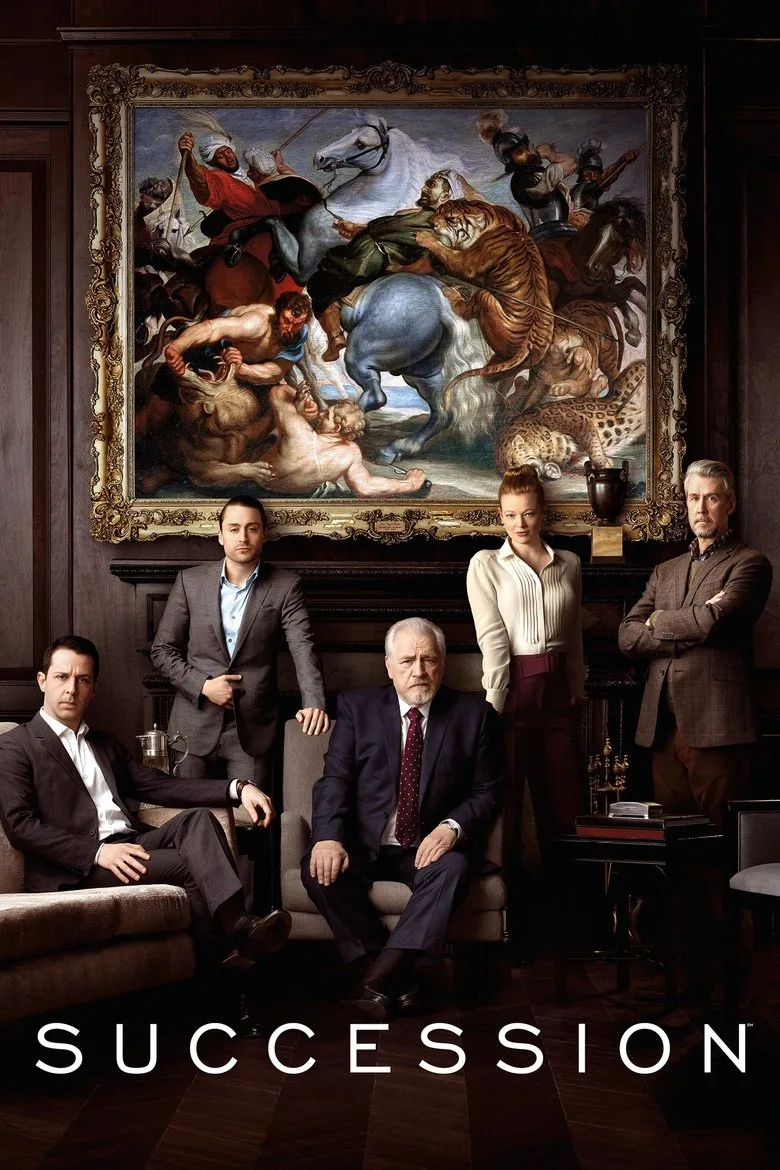
When the Game Begins and No One Knows When It Will End
Few series make you sit in front of the screen unsure whether you are watching a comedy or a tragedy. Succession is one of those rare works. From the very first episode, you sense that this show has no interest in making you comfortable. It wants you to watch a family eat itself alive from the inside, and to wonder at every turn: who will win this war? And more importantly — does any of them deserve to win?
The central premise seems simple on the surface: an aging father holds the reins of a vast media empire while his children circle the throne. But Succession does not settle for that surface. Beneath the layers of dark humor and tangled dialogue, a far deeper question hides: what does ambition do to a person when it finds no limits?
The Structure of the Ending: When Every Expectation Breaks
What sets the ending of Succession apart from so many other dramatic series is that it offers no clear victory. There is no hero who gets everything they wanted. There is no comfortable moment of triumph. Instead, events conclude somewhere that resembles a void — as though all that prolonged conflict produced nothing worth mentioning, save for an accumulating pile of losses.
This dramatic choice is deliberate and intelligent. Throughout its entire run, the series taught us one thing: power does not go to the most deserving, but to whoever is willing to surrender the most essential part of themselves. When the ending finally arrives, it becomes clear that the price was so steep that even the winner does not look like one.
In my view, this is precisely what makes the ending of Succession so painful — because it forces you to realize that you spent all this time rooting for people who did not deserve it, and sympathizing with characters who behave in ways that make your sympathy a quiet indictment of yourself.
The Characters at Their Final Stop
Jeremy Strong as Kendall delivers perhaps the most agonizing performance in the series. His character carries a sharp internal contradiction: he wants to prove his worth to his father, yet every time he draws close to that goal, he falls apart. The ending brings this contradiction to its peak. Kendall at the end of the road does not appear as a man who got what he wanted or simply lost — he appears as a man suspended somewhere between the two, which is the most crushing kind of loss of all.
Kieran Culkin as Roman draws a character who uses humor and sarcasm as a shield. But the ending strips Roman of that shield entirely. What remains is something more honest and more broken. And that is precisely what made watching his dramatic arc feel rewarding despite all its complexity.
Sarah Snook as Siobhan portrays a character who believed — or wanted to believe — that she was different from her siblings. That she possessed a genuine conscience rather than a mere performance of one. The ending reveals that the gap was never as deep as she imagined. That revelation is one of the most honest and most brutal moments the series has to offer.
Brian Cox as the father remains the gravitational center even in his absence. His character is the one that defines every other character in relation to itself. And when the game is over, it becomes clear that his shadow is too large to disappear simply because the equation has changed.
The Deeper Meaning: Inheritance as Burden, Not Gift
Have you ever wondered why people compete so ferociously for things that will never make them happy? That is the question Succession poses in silence, season after season.
Inheritance in this series is not merely the transfer of a company or a fortune. It is the transfer of wounds, psychological patterns, and broken relationships. The children are not competing only for power — they are competing for the recognition of a father who will never grant it in the way they need. And that is what makes every victory hollow from the very start.
The score by Nicholas Britell plays a crucial role in building this psychological weight. The melodies he chose blend something that resembles grandeur with something that resembles grief, all at once. As if to say: this world looks dazzling from the outside, but from within, it groans.
Matthew Macfadyen as Tom offers a different model — an outsider trying to break into the inner circle at any cost. His ending raises a question about the nature of belonging and ambition when both are built on cold calculation rather than genuine connection.
Our Take on the Ending and What It Leaves Behind
I noticed something rare in Succession: the series never explicitly judges its characters, yet it makes you judge them — and then makes you second-guess your judgment again and again. That kind of writing requires enormous trust in the audience.
The ending does not close all the doors. It leaves open spaces that each viewer fills in their own way. And I believe that is precisely what makes it a mature ending — because real life does not arrive with tidy, unambiguous conclusions.
What lingers after the series ends is not an answer to who won. What lingers is an image of a family that could have been something else, had they chosen a different path at some point along the way. But they did not choose it. And that is the real wound that Succession leaves in everyone who watches it.
In the end, Succession is not simply a series about power. It is a series about the things we lose while running toward what we think we want. And that alone is enough to make it one of the most thought-provoking dramatic works deserving of reflection.
📝 This article is an editorial piece based on publicly available information about the show. The author's opinions do not necessarily represent the platform's position, and some details may differ from official sources.