

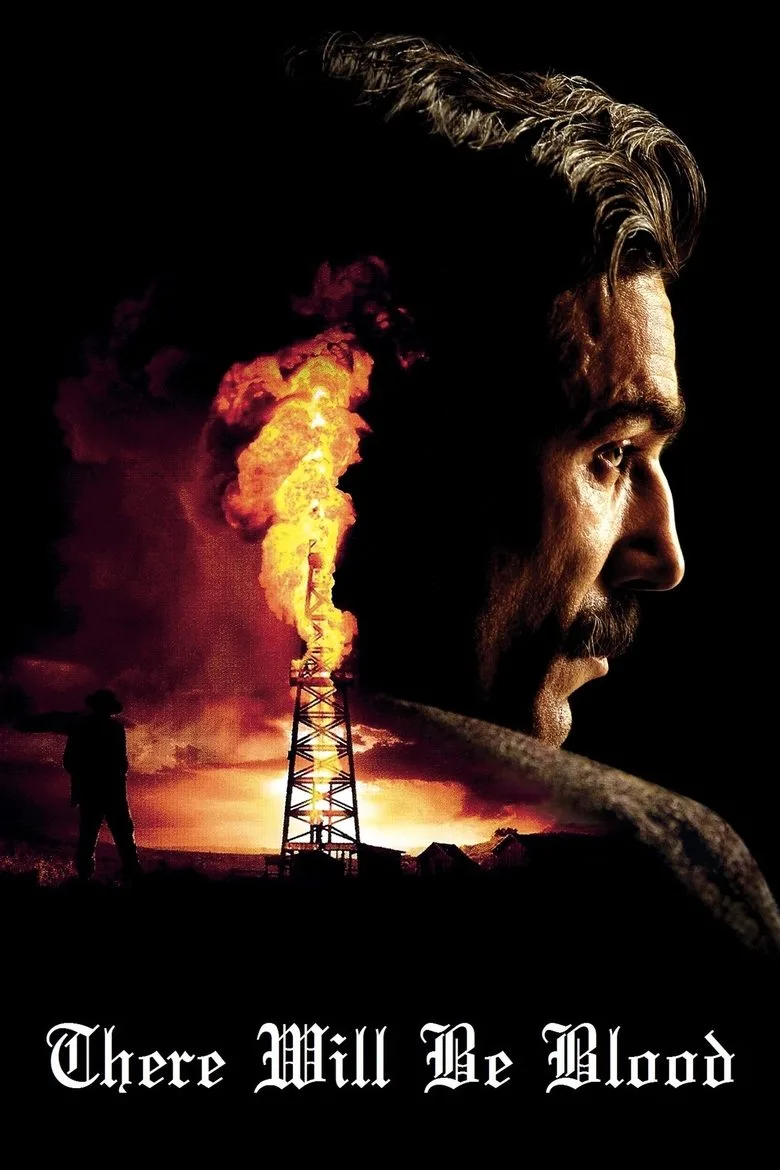
Analysis of There Will Be Blood 2007 — Ideas, Symbols, and Meanings
There Will Be Blood is not merely a drama film about greed and oil in early America, but rather a complex psychological study of the nature of modern man and his relationship with power, property, and belief. Director Paul Thomas Anderson presents a work worthy of academic study, one that transcends surface narrative to dive into the philosophical depths of the question of ambition and moral corruption.
The Central Idea: Greed as a Civilizational Turning Point
The film opens with a nearly silent, primitive scene, where Daniel Plainview works in the depths of a silver mine. This opening is no accident; it symbolizes the birth of capitalism from the womb of slavery and suffering. The film poses a fundamental philosophical question: Are greed and material ambition two sides of the same coin, or are they distinct manifestations of different aspects of human nature?
Through the character of Plainview, we witness a gradual transformation from struggling for survival to an unlimited pursuit of power and control. This transformation is not inevitable so much as it is a conscious choice, made by the man at every moment, which elevates the film from the level of determinism to the level of moral responsibility. Anderson tells us: greed is not an inherited trait so much as it is a perverted will.
Analysis of Main Characters: The Conflict Between Two Models
Daniel Plainview: The Modern Beast
Daniel is not simply an ambitious businessman; he is a psychological study of a psychopathic personality that hides deep weakness beneath a mask of power. Daniel Day-Lewis's performance is not merely an acting performance, but an embodiment of a complex psychological state. When he uses his son H.W. as a tool for trust, he does not do so out of a desire for paternal love, but because love itself is an economic concept in his world — an investment that carries potential returns.
The famous line "I want to earn enough money so I can get away from everyone" reveals a condensed truth: Daniel does not seek wealth for security or comfort, but for power over others. The film's ending, where he reveals that he killed his first partner, is not a surprise so much as it is a confirmation of what was clear from the beginning — that Daniel is capable of anything to achieve his dreams.
Eli Sunday: Faith as a Tool of Power
Eli Sunday forms the opposing counterpart to Daniel. Both seek power, but through different mechanisms. Daniel uses economics, while Eli uses religion. This parallel is not a magical equation, but a sharp comparison: both systems — capitalism and religion — can become tools of oppression and control when they fall into corrupt hands.
The conflict between them is not moral as it may appear at first glance. Daniel is not the evil one and Eli the righteous. Rather, both seek power through different mechanisms, and both are prepared to sacrifice morality to achieve it. The difference is that Daniel is honest with himself about the nature of his desires, while Eli hides them behind a religious veil.
Symbols and Meanings: A Poetic Reading of Ruin
Oil and Blood
The film's title "There Will Be Blood" is not a metaphor; it is a prophecy. The black oil in California soil is not merely an economic commodity, but the hidden blood of the earth. The deeper Daniel digs, the more blood he extracts. This symbol points to the fact that development and extraction are not neutral activities, but rather acts of destruction and depletion.
The visual scenes of oil flowing and fires blazing paint an infernal picture. Anderson does not portray oil as a source of wealth and civilization, but as a source of destruction and savagery. Even material victory comes with an exorbitant price — environmental and spiritual ruin.
The Child H.W. and Lost Innocence
H.W. represents innocence that is tainted by adult greed. Daniel's use of his son is not an incidental crime, but a miniature model of the way he treats all the people around him. The deaf child at the end of life reflects the loss of everything human in this world.
The Hidden Message: Critique of Americanism and Modernity
The film does not criticize greed in the abstract; rather, it criticizes the American Dream itself. The United States was built on myths: the myth of opportunity available to all, the myth of the self-made man, the myth of freedom. But Anderson reveals that these myths are built on blood — the blood of Native Americans, the blood of workers, the blood of the earth itself.
The small community in the film represents real America: simple, religious, hardworking, exploitable. And men like Daniel and Eli are the true model of American leadership — no morality, no mercy, only a relentless pursuit of power. Both use language, masks, and deception to achieve their goals, and both succeed completely.
The film's ending, where Daniel kills Eli in a crowded bar, does not represent the triumph of evil over good, but the triumph of one mechanism over another — economics over religion. No moral victory, just the triumph of the more efficient power.
Conclusion: Art as Testimony to Decay
There Will Be Blood remains one of those films that refuses easy comfort. There is no happy ending, no reformation of the villain, no triumph of good. There is only the triumph of one cruel mechanism over another. The film presents a dark vision of modern civilization, where all human values are replaced by an unlimited pursuit of power and property.
What makes the film important is not that it says something new, but the way it says it. Through Jonny Greenwood's tormented score, through suffocating cinematography, through acting that leaves no room for mixed interpretation. Anderson does not leave us room to escape from the bitter truths he presents.
In the end, There Will Be Blood is a film about the world as it is, not as we wish it to be. And perhaps this is the true value of art — to be an honest witness to our era, even if that testimony is frustrating and cruel.
📝 This article is editorial and based on publicly available information about the film. The author's opinions do not necessarily represent the position of the platform, and details may differ from official sources.