

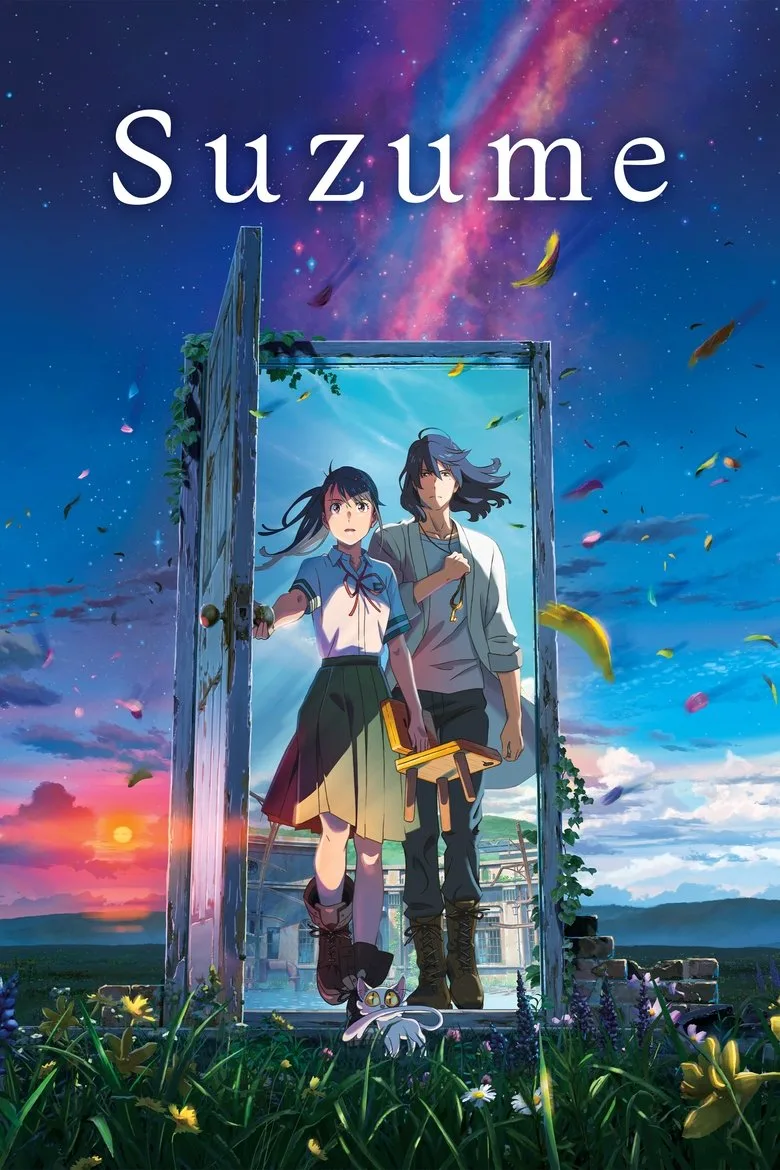
The film Suzume's Locking Door represents a multi-layered cinematic work that transcends the boundaries of conventional animation, becoming a profound mirror that reflects Japanese anxiety about natural disasters and individual responsibility within a collective society. The film's importance is not limited to the quality of its visual execution, but rather to its ability to weave complex philosophical threads about guilt, redemption, and spiritual maturation, making it a cinematic text worthy of careful critical analysis.
The Central Idea: The Door as an Existential Threshold
At the heart of the film's cinematic narrative lies the symbol of the door, which is not merely a simple narrative element, but represents a point of intersection between multiple worlds and between consciousness and the unconscious. The mysterious door that Suzume discovers does not merely separate two geographical locations, but rather different existential states. It embodies the critical moment when a person transitions from the innocence of childhood to the responsibility of an aware individual.
This dual symbol operates on two parallel levels: on the surface level, the door is the direct cause of the catastrophe threatening Japan; on the deeper level, the door is a representation of Suzume's choices and her inability to control the consequences of her actions. The film poses a specific philosophical question: to what extent are we responsible for the unintended consequences of our actions?
The director's choice to set the story geographically in Kyushu is not arbitrary, as this region of Japan has a rich history of volcanoes and natural disasters, grounding the story in a genuine Japanese cultural context where coexistence with turbulent nature is part of the collective identity.
Analysis of Main Characters: Growth and Transformation
Suzume herself embodies the archetype of the modern hero who lacks self-confidence and inner strength at the beginning. She is not a fierce warrior or a powerful sorceress, but an ordinary girl dealing with completely ordinary social problems, such as school and social relationships. This choice makes her relatable to a broad audience and elevates the value of her transformation when she is forced to perform a heroic act.
Suzume's psychological journey is not about acquiring supernatural powers, but about accepting responsibility and acknowledging guilt. This is what distinguishes the film from classical narratives of the superhero. Suzume does not save the world because she possesses special powers, but because she realizes she has a moral duty regarding her mistakes. This development reflects a Japanese philosophical perspective on individual responsibility within a collective context.
The mysterious young man whom Suzume meets represents a mediator between worlds, a character suffering from his own isolation. Their relationship does not develop as a conventional romance, but as a bond of understanding between two people who comprehend loneliness and isolation. This narrative choice deepens the film emotionally and saves it from the expected classical paths.
Symbols and Meanings: A Deep Reading of Images
The animation in the film is not merely a beautiful visual element, but carries deep philosophical meanings. The free use of color and movement conveys complex psychological states without requiring dialogue. When Suzume enters the fantasy worlds, we see a transformation in the drawing style itself, reflecting the shift in her mental state from realism to magic.
The places Suzume visits are not random: ruins of buildings, abandoned roads, empty cities. All these images reflect a deep anxiety about destruction and annihilation, an anxiety rooted in the modern Japanese experience following earthquakes and tsunamis. The film makes this anxiety tangible through powerful visual representation.
The use of music and sound effects reinforces this symbolic dimension. Stifled sounds and melancholic music create an atmosphere of anxiety and tension, even in moments when the narrative seems light. This contradiction between form and content creates a psychological tension that remains with the viewer after the film ends.
The Hidden Message: Collective and Individual Responsibility
Although the film presents itself as a fantasy adventure, its fundamental message concerns the balance between individual responsibility and collective responsibility. Suzume did not intend to open the door, but she bears responsibility for its consequences. This reflects on the broader social level where each individual is responsible for what they do, even if unintended.
The film also questions the nature of redemption and punishment. Can an individual atone for their mistakes through work and perseverance? Is the pain Suzume endures on her journey sufficient to compensate for the damage? These questions find no easy answers, and this is what makes the film philosophically advanced.
Another hidden message relates to Japan's geographical and cultural position. A country living in constant coexistence with natural forces that threaten it, and must develop mechanisms for dealing with disasters. The film reflects this reality through Suzume, who acknowledges her responsibility and moves to correct it, perhaps as a metaphor for Japanese society itself.
Conclusion: The Drama of Maturity and Complexity
Suzume's Locking Door stands in a unique place among contemporary animated films, not because it presents an exciting adventure, but because it uses fantasy as a language to explore deep human questions. The narrative does not ignore beautiful visual form, but neither does it allow it to dominate intellectual content.
The film achieves a rare balance between popular appeal and intellectual depth. It can be watched as an exciting adventure story on the surface, but beneath this surface lie layers of meaning about guilt, maturity, and responsibility. This intellectual richness combined with high visual quality makes it an important addition to contemporary animated cinema.
The film's true value lies in its ability to make the viewer contemplate questions specific to themselves: what is my responsibility regarding my actions? How do I deal with guilt and regret? This internal dialogue that the film creates is a sign of a mature and deeply impactful cinematic work.
📝 This is an editorial article based on publicly available information about the film. The author's opinions do not necessarily represent the platform's position, and details may differ from official sources.