

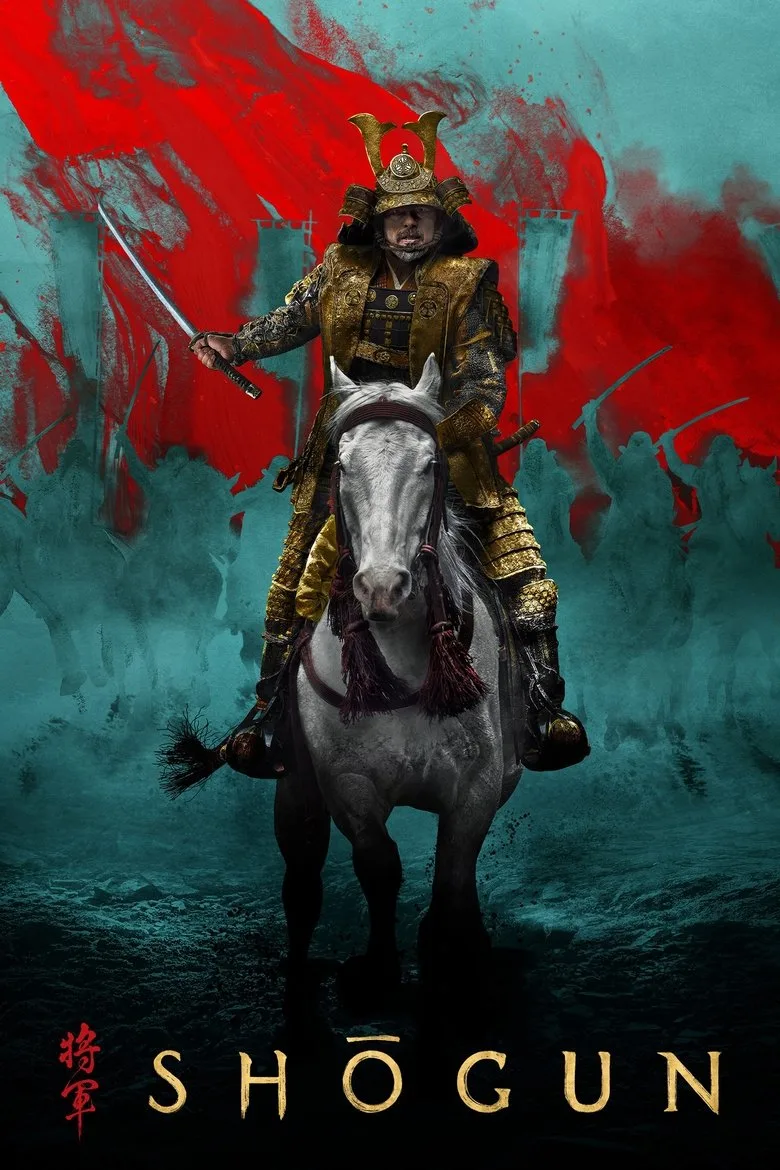
Shōgun 2024 Analysis — Themes, Symbols, and Meanings
When Civilizations Collide, It Is Not the Weaker That Falls — It Transforms
Shōgun is not merely a drama revisiting feudal Japan in the late sixteenth century. It is a philosophical trial of power, identity, and the way human beings redefine themselves when thrown into the middle of a culture whose language and symbols they do not understand. The American series produced by FX in 2024, adapted from James Clavell's celebrated 1975 novel, operates on multiple interwoven layers and never settles for what appears on the surface. ---The Central Idea: Power Is Not a Force to Be Possessed, but a Language to Be Mastered
At the heart of this work lies a single question that poses itself quietly yet urgently: what makes a person capable of ruling? Lord Toranaga does not hold the majority within the Council of Regents, nor does he command the largest army at the outset, nor does he possess allies who can be fully trusted. Yet he holds something far rarer: the ability to read others before they read themselves. For him, power is not a fixed given but a continuous practice — a daily ritual of observation, waiting, and acting at precisely the right moment. The series offers a quietly sharp critique of the Western understanding of power, which is built on direct confrontation and rigid hierarchical structures, and proposes an alternative drawn from Japanese philosophy: power as flexibility, as acceptance of impermanence as an inescapable truth, and as the deployment of silence as a political statement more eloquent than any words. The temporal setting of the events — around the year 1600, on the eve of the historic Battle of Sekigahara — is not an arbitrary choice. It is a moment in which one order breaks apart and another is born, and this lends the events exceptional weight: every decision taken and every alliance forged carries the burden of an entire history. ---Analysis of the Main Characters: Three Mirrors of a Single Philosophy
Toranaga: Silence as a Strategic Weapon In the majority of the series' scenes, Toranaga refuses to be a reaction. He is always the deferred action that arrives at exactly the right time. His enemies classify him as "a coward who evades battle," and that is precisely what he wants them to think. His character embodies the concept of "active emptiness" in Taoist philosophy: immersion in non-action does not signify powerlessness but rather the patience to wait until circumstances ripen. The performance delivered by Hiroyuki Sanada deserves extended consideration. There is no exaggeration of expression, no shouting, no theatrical outburst. Toranaga rules with a glance, threatens with a smile, and brings down his opponents with a silence that unsettles them far more than any words of his could. John Blackthorne (Anjin): The Stranger Who Becomes a Mirror Blackthorne, the English navigator whom fate casts upon a Japanese shore, represents something far deeper than the simple figure of "the white man lost in the East." He is an image of the Western mind stripped of all its familiar tools: his language is not understood, and his concepts of honor, war, and death appear primitive when set against the Japanese value system surrounding him. Most importantly, the series refuses to turn him into "the savior." Blackthorne is not a hero arriving to illuminate the darkness; he is a late learner, a man who slowly discovers that what he believed to be civilization is merely one answer among many to the same questions. His dramatic arc is, at its core, a journey of identity-stripping and reconstruction. This carries a clear philosophical meaning: true transformation does not happen through addition, but through letting go. Mariko: An Identity Suspended Between Two Worlds Mariko is the most complex character in this work, and yet the least present in most critical readings. She is a Christian woman in a Shinto society, loyal to her lord while living under the shadow of her father's betrayal of Toranaga. She carries within herself all the contradictions of the age: faith and loyalty, love and duty, individual identity and collective belonging. Her role as translator between Blackthorne and Toranaga transcends its literal meaning. She embodies the possibility of dialogue between two cultures that do not even share a unified concept of time or death. And when she chooses, at the end of her arc, the most radical act available to her, she declares that the deepest identity is not what we inherit but what we choose in the moment of truth. ---Symbols and Meanings: What Is Left Unsaid Means More Than What Is Said
Japanese Chess (Shogi) and Real War The strategic game that Toranaga plays in multiple scenes is not a visual ornament. In shogi, a captured piece is not removed from the game but passes into the opponent's possession and can be redeployed. This simple rule encapsulates the whole of Toranaga's political philosophy: no one is ever entirely spent, and even a defeated enemy can become a tool in a clever hand. The Ship: The Door That Cannot Be Closed Again The appearance of the European vessel in the remote village is not merely an event that ignites the story. It is a symbol of the moment in which a closed world becomes open beyond return. The series presents this opening neither as an absolute blessing nor as a curse, but as a simple truth: once two worlds have seen each other, neither can ever be what it was before. Death Rituals: Seppuku as a Sovereign Act The series addresses the practice of seppuku — ritual suicide — with remarkable depth and an explicit avoidance of superficial ethnographic interpretation. Voluntary death in this context is not despair; it is the last act of sovereignty a person holds over themselves. It is the boundary between what others can wrest away and what remains forever beyond the reach of their power. This concept raises a genuine philosophical question, particularly for the Western viewer: is resistance to death always a sign of strength? Or are there circumstances in which the conscious choice of one's own end becomes a form of dignity? ---The Hidden Message: A Critique of Globalization from a Century Past
Beyond its dramatic momentum, the series carries a message that critiques the present moment using the tools of history. The relationship between the Japanese and the Europeans in this work redraws the map of contemporary tensions between North and South, between expansionist cultures and those that resist forced assimilation. Yet the series avoids comfortable binaries. There is no simple "good and evil" here. The Portuguese are not one-dimensional colonial demons, just as the Japanese are not disinterested sages above self-interest. Everyone exercises power according to their own logic, and this is precisely what makes the picture truer to reality than most historical works. The deeper message is that dialogue between cultures does not always lead to consensus, and that understanding does not mean acceptance. What keeps dialogue possible and fruitful is the mutual recognition that the other possesses a complete value system — and is not merely an absence of what you yourself carry. ---Conclusion: What Remains When the Battle Is Over?
In the final analysis, Shōgun poses a question that transcends politics, war, and cultural identity: what is the true price of victory? Toranaga achieves his goal, but the series does not present this as a moment of celebration. Every alliance has collapsed, every friendship has fractured, every person he loved or used has either changed or departed. Power, once acquired, sits upon its throne alone — and that solitude is not a dramatic punishment but the logic of things in a world that draws no distinction between strength and isolation. This work, in my view, deserves to be read as a philosophical text before it is read as historical entertainment. It invites the viewer to reexamine their assumptions about strength and weakness, about progress and backwardness, and about the true meaning of survival in a world that changes without cease.📝 This article is an editorial piece based on publicly available information about the series. The author's opinions do not necessarily represent the platform's position, and some details may differ from official sources.