

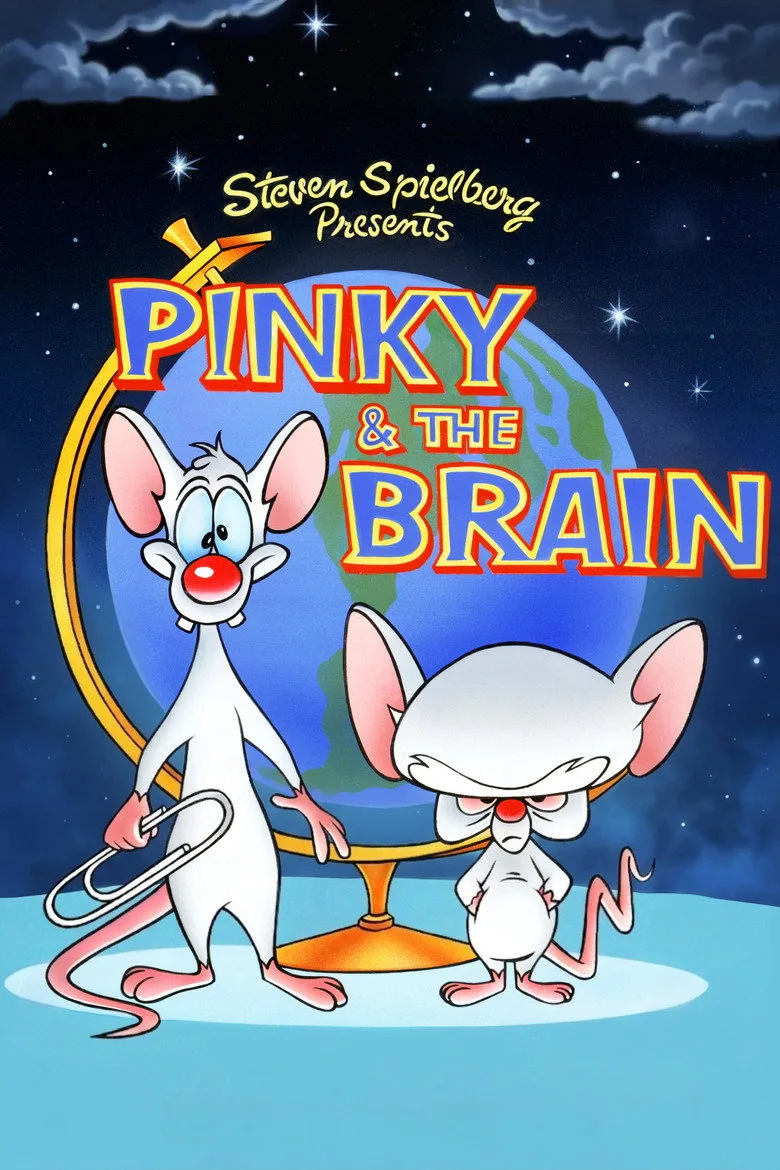
Pinky and the Brain cannot be understood merely as an animated program directed at children; rather, it should be viewed as sharp criticism and intelligent satire of the nature of human ambition and the pursuit of power. The program launched by Warner Brothers in 1995 represents a unique model in American animation, combining naive humor with profound philosophical commentary in a way that children may not fully comprehend, yet adults sense with complete clarity.
The Central Idea: The Cycle of Failure as a Repository of Meaning
At the heart of the program lies a deeply penetrating philosophical idea: the repetition of attempting to take over the world each night, with guaranteed failure each time. This is not merely a mechanical repetition of the scenario, but rather a profound metaphor for the human condition itself. Pinky and Brain embody the contemporary principle of Sisyphus — the worker who pushes the rock upward each day, only for it to slide back down again.
The repeated scenario reflects a terrifying truth about ambition: that it carries within itself no guarantees of success. The program mocks the idea of the "perfect plan" that haunts millions of people daily. Each night, Brain believes he has discovered the magical formula, the plan that cannot fail, yet he overlooks one factor: the existence of Pinky, who represents chaos, chance, and external factors beyond control.
Analysis of Main Characters: Mind and Foolishness as Poles of Existence
Brain is not merely a "cunning genius" as the synopsis describes him. He is an embodiment of pure logical intellect, attempting to impose order on a world that is chaotic by nature. Brain's plans are always tightly constructed, based on sound reasoning and precise calculations. Yet his genius carries within it a fundamental blind spot: the assumption that reality will move according to equations and paper plans.
Pinky, on the other hand, is not merely "simple-minded" as he appears on the surface. Pinky represents intuition, instinct, and absurdity. He says what he thinks directly, without filtration or complex calculations. Notably, Pinky's actions — which appear random — are often the true reason for sabotaging Brain's plans. There is here an implicit criticism of the culture of perfection and excessive planning that dominates modern consciousness.
The dynamic between the two characters reflects an eternal human struggle: the conflict between mind and emotion, between planning and spontaneity, between the desire for control and acceptance of chaos. Brain represents human ambition in its purest form, while Pinky represents a reality that refuses to yield to tightly constructed plans.
Symbols and Meanings: The Laboratory as a Metaphor for Modern Life
The choice of the laboratory as a setting is not random. The laboratory represents modernity, technology, scientific rationality. And in this organized and sterile space, two mice attempt to go out and take over the outside world. There is clear irony here about the isolation of intellectuals and technicians from the actual reality of society.
The night also carries important symbolic meaning. The choice of night for working on schemes is not merely practical, but reflects the secret and hidden nature of all human ambition. The night is a time of dreams and imagination, where impossible plans seem possible. As dawn breaks, realism returns, and the real world flows in again.
The Hidden Message: Sharp Criticism of System and Authority
While the program appears to be mere surface comedy, it contains deep criticism of power and hierarchies. Pinky and Brain live at the bottom of the pyramid — small mice in a laboratory — yet they do not surrender to reality. Instead, they attempt to climb to the top. The program asks: is ambition noble, or is it merely an illusion that helps us bear our bitter reality?
The true irony lies in the fact that our actual society is filled with real "Brains" attempting to take over the world using logic that ignores chaos and randomness. Politicians, businessmen, managers — all of them conduct the same conspiracy every day, expecting different results. The program displays this madness in a comedic way, allowing us to see it and laugh at it simultaneously.
Chaos as a Tool of Liberation
What truly distinguishes the program is its unstated conclusion: chaos is not an enemy, but rather an integral part of life. Pinky, in all his simplicity, lives in peace with this truth. He is not disturbed by failure, because he has not become too attached to success. Brain, on the other hand, suffers from constant frustration, because he refuses to accept chaos as part of reality.
There is valuable psychological wisdom here for adult viewers: attempting complete control over life may be harsher than accepting some chaos. The truly successful characters in real life are not those with a perfect plan, but those who can adapt to the unexpected.
The Social Dimension and Cultural Criticism
The program also reflects anxieties of the 1990s about modernity and globalization. Each night carries a different social theme: media manipulation, genetic engineering, large institutions, popular culture. Brain attempts to harness all these modern tools for his own purposes, yet the truth is that he falls victim to the same forces he attempts to control.
Conclusion: Beauty in Repeated Failure
Pinky and the Brain is not about success or failure so much as it is about the attempt itself. It is a strange celebration of human persistence in continuing to try, even in the face of near-certain probability of failure. This is what makes the program multi-layered — children can laugh at simple comedic situations, while adults can contemplate the deep existential messages.
In the age we live in, where a culture of success and achievement dominates our lives, this program comes as a cheerful yet wise cry: perhaps it is not about reaching the top as much as it is about enjoying the journey of climbing, even if we slip again and again. Pinky and Brain know that the next night will bring a new attempt, and that — in some way — is enough.
📝 This article is editorial content based on publicly available information about the film. The author's opinions do not necessarily represent the position of the platform, and details may differ from official sources.