

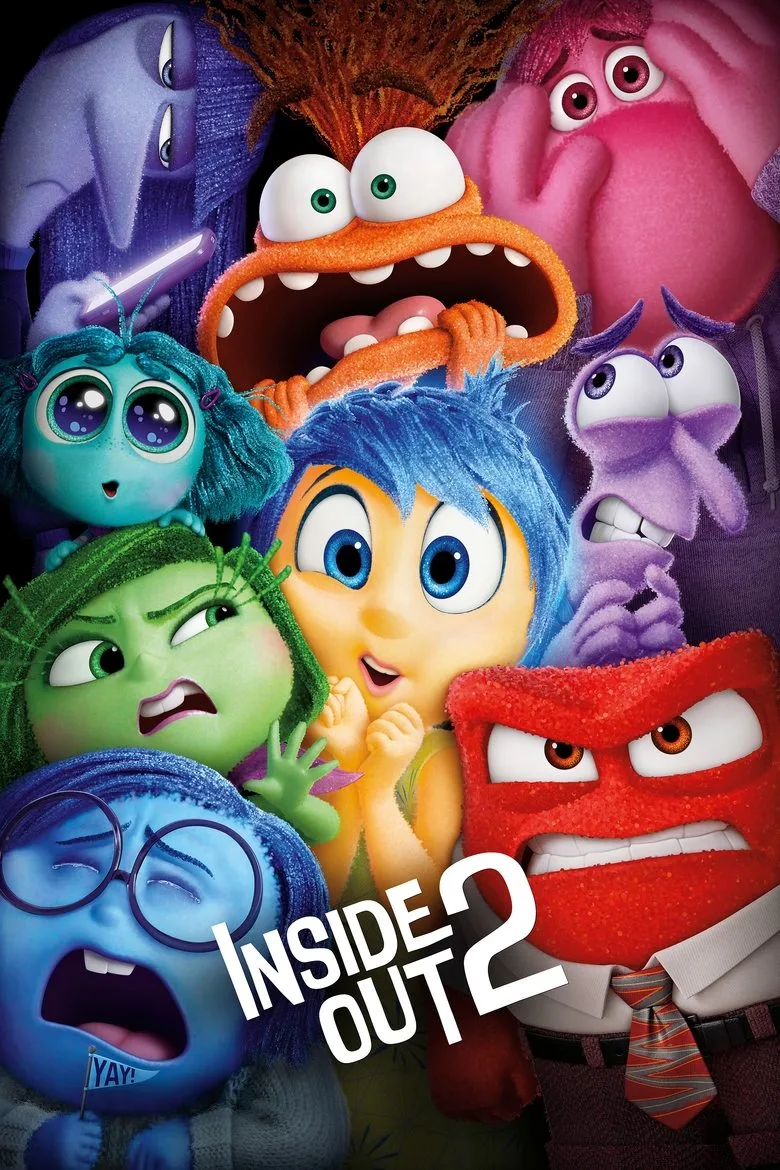
Director Kelsey Mann returns with the Pixar team in Inside Out 2 not to repeat the success of the first installment, but to venture into deeper and more complex exploration of the terrain of the human mind. The film is not merely a dramatic continuation of Riley's story, but a bold philosophical reflection on the phase that separates childhood innocence from the chaos of adolescence. The film maps out the psychological transformation that happens within all of us, a moment when we realize that the world is more complicated than what we were taught, and that our emotions are deeper than mere primary colors.
The Core Idea: Adolescence as the Death of Simple Truth
At the heart of the narrative lies a bold idea: adolescence is not merely a life stage, but a genuine upheaval in the structure of consciousness. The first Inside Out presented us with a pure model of the human mind, where five basic emotions control behavior with direct mathematical precision. But the second installment boldly dismantles this simple architecture, to assert that true maturity means understanding that life is far more ambiguous. The emergence of new emotions such as anxiety, envy, and doubt is not random, but represents an increasing awareness of the complexities of existence.
This transformation reflects a deep psychological truth: a child lives in a world of simple dichotomies (right/wrong, safe/dangerous), but the adolescent enters a world of subtle distinctions and contradictions. The film embodies this transition with remarkable narrative intelligence, where old emotions do not disappear but are reframed within a more complex context. Joy does not vanish, but it becomes more cautious, more aware that every joy carries within it the possibility of loss.
Analysis of Main Characters: The Conflict Between Emotional Generations
The characters in the film are not merely embodiments of abstract emotions, but represent stages of human consciousness. The five original emotions (joy, sadness, anger, fear, and disgust) represent the classical era of human psychological development. Their continued presence in the film, despite the appearance of new arrivals, suggests that maturity does not mean replacing the old with the new, but integrating them into a more balanced system.
The new emotions, particularly anxiety, represent a genuine psychological phenomenon in adolescence. Anxiety is not an illness in the film's context, but a logical response to a world that has suddenly become far less predictable. This humanistic and empathetic portrayal of anxiety distinguishes the film from the prevailing cinematic discourse that reduces adolescence to depression or shallow rebellion. Instead, the film presents anxiety as a true guardian, sometimes dysfunctional, but operating from a foundation of love and protection.
The interaction between Riley and the characters of her mind acquires a new dimension in the second installment. Riley is no longer merely a passive recipient of the mind's decisions, but an agent who is aware of these internal voices. This development reflects an important truth: human maturity begins with the ability to observe one's thoughts and feelings rather than merely being immersed in them.
Symbols and Meanings: The Archive as Memory Station
The physical setting of the story, the headquarters and its annexes, functions as a complex symbol for the human mind. The organized geometric design of the first installment now undergoes dramatic reconstruction. This visual chaos on screen is not a cinematic flaw but an explicit representation of the genuine turmoil that accompanies growth.
Memory itself becomes a central subject. The film does not forget that memory is not a passive repository of information, but a living and dynamic process. Memories change over time, are reframed through a new perspective. This is a subtle reflection of a psychological reality: Riley does not lose her memories, but reinterprets them. A happy event from the past may now be viewed with a more complex vision that includes pain or loss accompanying it.
Color functions as a powerful symbolic element. While basic emotions had their clear colors, the new emotions carry color gradations that are not clearly defined. Anxiety, for example, appears in disturbing purple tones, while envy takes on more muted shades. This visual choice is not arbitrary but reflects the nature of these emotions themselves: more convoluted and less definable than childhood emotions.
The Hidden Message: Accepting the Inner Shadow
On a deeper level, the film poses a truly Jungian question: can we accept the dark parts of ourselves? The new "negative" emotions are not enemies to be disposed of, but necessary parts of the fabric of healthy consciousness. This challenges popular culture that often attempts to ignore or suppress emotions deemed "bad."
Anxiety, despite its annoying appearance in the film, accomplishes a real task. It protects Riley from dangers, pushes her to prepare and be ready. Envy reflects a genuine desire for social connection and belonging. Even doubt serves a purpose: it drives us to question and grow. The message is not "get rid of these emotions" but "learn to live with them, understand their true needs."
This balanced psychological approach of the film is what elevates it above simple entertainment. It reflects a deep understanding of human psychology, an understanding that says that mental health is not the absence of negative emotions, but the presence of a dynamic balance that allows all emotions to contribute to the decision-making process.
The Dialogue Between Comedy and Drama
The film's choice to blend sharp humor with emotional depth is not easy. There are purely comedic scenes related to familiar teenage behaviors, but these laughs do not hide a deeper truth: that the transformation Riley is undergoing is truly painful. The film states, without hesitation, that maturity means losing something. The innocence of childhood, the simple clarity, absolute trust in adults. This loss is real and worthy of grief.
There are scenes that will make adolescents feel that their feelings are understood and valid, and will make parents empathize more deeply with the chaos they are going through. This emotional bridge between generations is a genuine achievement of the film.
Conclusion: Toward a More Complex Understanding of Humanity
Inside Out 2 is not merely a family animated film, but a serious reflection on the nature of human growth. It says that adolescence is not a phase to be gotten through, but a radical transformation to be understood and respected. The new version of Riley, sometimes bothersome, anxious, and envious, is not a worse version than the old innocent one. It is a more human version, more capable of living in a complex world.
The film acknowledges the reality that none of us remains in our innocence. We all transition from simple worlds to ambiguous ones. The beauty lies in the way we choose to navigate through this ambiguity, and how we learn to accept all aspects of ourselves. In the end, the film offers a liberating message: you are more than your emotions, stronger than your anxiety, and more beautiful because of all your contradictions.
📝 This article is editorial and built on publicly available information about the film. The author's opinions do not necessarily represent the platform's position, and details may differ from official sources.