

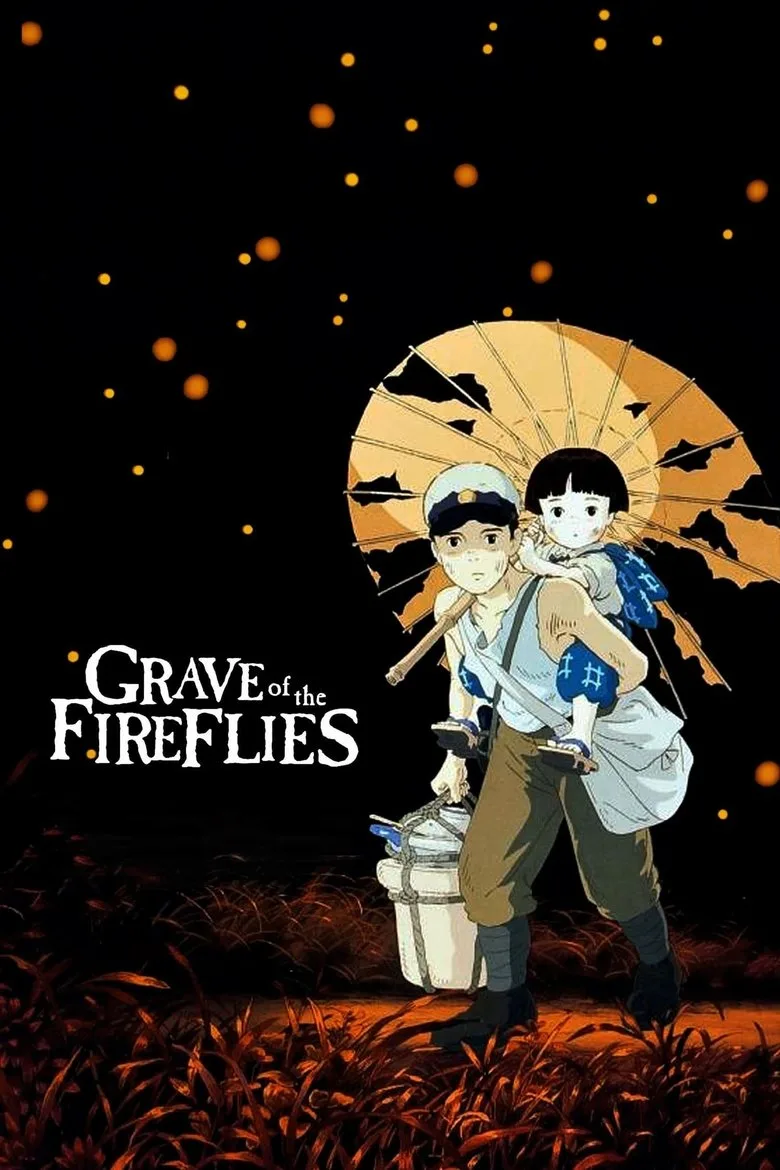
Grave of the Fireflies remains one of Japanese animation’s most affecting films because it does not treat war merely as historical background. It turns war into a test of family, responsibility, and memory. Directed by Isao Takahata and produced by Studio Ghibli, the film is based on Akiyuki Nosaka’s semi-autobiographical short story.
Why does Grave of the Fireflies feel different?
The film’s power does not come from spectacle or direct speeches. It comes from staying close to two children trying to understand a world that has become too heavy for them. Seita and Setsuko are not abstract symbols; they are young characters placed inside a harsh reality where even ordinary decisions carry painful weight.
That is why the film works as more than a simple anti-war statement. It becomes a human story about what happens when family, society, and institutions fail to protect the most vulnerable.
The symbolism of the fireflies
The fireflies are not just a beautiful image. Their brief glow creates moments of warmth in a troubled world, while also reminding us how fragile beauty and safety can be. The title connects light with absence, memory with loss, and childhood with something that cannot easily be restored.
The symbol works quietly. The film does not need to explain everything directly; we understand that comfort has become rare, and that the characters hold onto small lights in order to keep going.
Seita and Setsuko: protection, not adventure
The bond between Seita and Setsuko is the heart of the film. Seita tries to carry a responsibility larger than his age, while Setsuko remains tied to the simplest needs of childhood: safety, food, closeness, and reassurance. This contrast gives the film its emotional force without needing exaggerated language.
Importantly, the film does not present Seita as either a flawless hero or a simple mistake-maker. He is a young boy facing conditions far beyond him, and his choices must be read through fear, pressure, and the absence of guidance.
The film as memory, not a simple lesson
Grave of the Fireflies does not offer an easy answer. It leaves viewers with a difficult human memory. War is not reduced to battle, victory, or defeat; it is shown through its effect on small lives with no political voice and no real power to protect themselves.
That is why the quieter images can be more powerful than the loudest moments. Takahata lets everyday details carry meaning: a small meal, a candy tin, a temporary shelter, or a silence between siblings.
Is the film suitable for every viewer?
Although it is animated, this is not light viewing for young children. Its subject matter is emotionally heavy and deals with war, loss, and psychological pressure from a deeply human angle, so it is best approached with care.
You can open the full CinemaHook title page for rating, story summary, and viewing details here: Grave of the Fireflies.
Bottom line
The strength of Grave of the Fireflies is that it does not ask viewers to react to an abstract idea, but to small lives shaped by forces beyond them. It is a film about war, but even more than that, it is a film about fragile safety and society’s responsibility toward those who cannot protect themselves.
That is why the film still matters decades later: it uses memory not as decoration, but as a reminder that history is often felt first through the smallest details.