

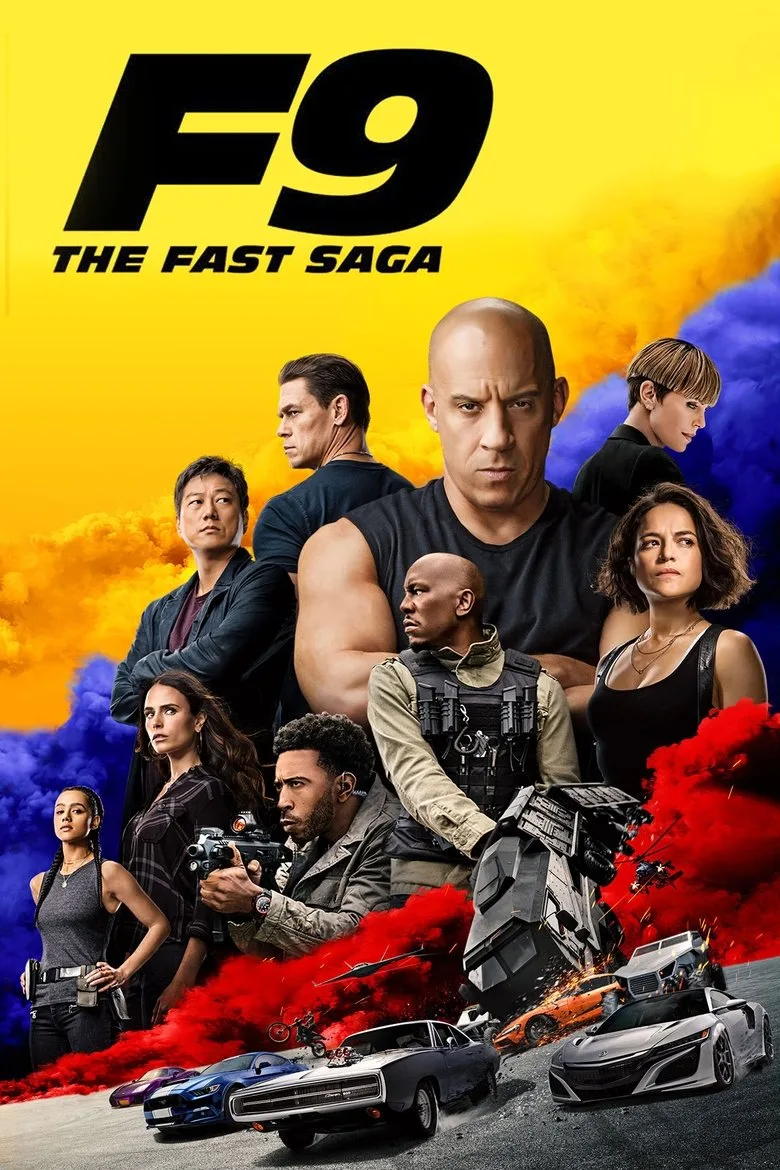
F9 2021 Analysis — Themes, Symbols, and Meanings
F9, or "Fast & Furious 9," is not merely an action film that puts cars on the road and unleashes chase sequences. At its core, it is a cultural document that reveals how a massive commercial franchise can build its own mythology around the concept of family — and then test the resilience of that concept against some of the most destructive emotions a human being can feel: jealousy, the sense of abandonment, and the need of blood to be acknowledged. Director Justin Lin, returning to the chair after an absence, plants a philosophical question at the heart of every explosion and every chase: Is family a voluntary construct built from shared values and sacrifice, or is it an inescapable biological fate? ---The Central Idea
Since the first installment of the franchise, the makers of Fast & Furious have cemented a single, unwavering moral message: family is the last fortress against chaos. Yet the ninth chapter dares to fracture that message from within, not from without. Jakob Toretto, the forgotten brother, does not arrive from a social vacuum or from some alien hostile environment; he comes from the very same womb, the very same childhood, the same father who died before his eyes too. He is not the enemy arriving from outside — he is the mirror that Dom fears looking into. This idea makes the film far more thought-provoking than its glossy surface suggests. The conflict between the two brothers is not a struggle between good and evil in the classical sense; it is a clash between two different accounts of the same event. Dom sees himself as the protector and the self-sacrificing one, while Jakob sees himself as the abandoned victim — pushed toward the abyss by a unilateral decision made by a brother who believed he was protecting but was, in truth, controlling. This duality of narrative is precisely what grants the film a depth that transcends its spectacular set pieces. ---Analysis of the Main Characters
Dom Toretto in this installment is not the customary triumphant hero; he is a man facing a long-overdue reckoning. The flashbacks the film relies on are not deployed for mere nostalgic purposes, but to lay bare decisions Dom made as the older brother — and how some of those decisions carried a harsh face beneath the cover of "protection." Dom builds his identity on the idea that he is an unshakeable rock, but Jakob topples that rock to reveal underneath it a man who ran from his guilt rather than confronting it. Jakob Toretto (played by John Cena) is the character who genuinely elicits the most sympathy in the film, even as he appears in the role of the villain. He is the product of early betrayal — a child who watched his brother choose principle over blood, and who grew up convinced that family is nothing more than a slogan deployed selectively. His alliance with Cipher is not merely an ideological choice; it is an act of symbolic resistance against the family that rejected him. The true intelligence in writing this character is that it never falls into the trap of "evil for evil's sake," but instead presents a man who was wounded in childhood and found no one willing to acknowledge that wound. Letty and Mia represent the rational feminine voice in the film, and they are the two parties who carry a clearer awareness of the situation's complexities. Mia in particular stands midway between her two brothers — a position that portrays the burden women bear within patriarchal families: to serve as emotional mediators in a conflict they did not create. Roman, Tej, and Han lean more toward comedy in this installment than is perhaps warranted, which at times undermines the film's dramatic weight. Yet Han's return carries an important symbolic dimension: that family can absorb even the most difficult and painful truths, and that what appears to be a betrayal may conceal behind it a deeper sacrifice. ---Symbols and Meanings
The car in this franchise has never been a mere vehicle; it is an extension of identity. Dom drives heavy, hulking cars because his identity is built on solidity and endurance. Jakob, by contrast, drives with intelligence and agility, because his identity is built on maneuvering and surviving in spaces where no place was ever designated for him. The chase between them is not only a physical pursuit; it is a visual metaphor for an emotional dispute over the true account of a shared past. The scene at the old racing track where their father once competed carries the significance of a common root that neither of them can deny. The late father constitutes a present absence throughout the entire film — he is the silent axis around which everything revolves. Who mourned him? Who truly carried him? Who betrayed him? These questions remain suspended in a way that makes the film more honest than it appears. The space that the vehicle reaches at the film's climax is a symbol with a dual meaning. On one hand, it is an expression of the cartoonish excess to which the franchise has arrived in its defiance of the laws of physics and logic. On the other hand, it is a metaphor for crossing boundaries — for the idea that this family does not recognize the impossible because it believes that collective will is stronger than any law of nature. The problem is that this excess breaks the implicit contract with the viewer, turning the miraculous from a dramatic exception into a routine expectation. The black-and-white flashbacks that return us to Dom and Jakob's childhood are among the most visually mature choices in the film. The black and white does not merely signal temporal distance; it evokes memory itself as a space where gradation disappears — where everything is reduced to black or white, innocent or guilty, victim or perpetrator. ---The Hidden Message
Beneath layers of action and explosions, F9 poses a sharp social question about the nature of family solidarity in collectivist cultures: Can a family contain its mistakes and acknowledge them? Or does it always tend to favor comfortable narratives at the expense of internal justice? Jakob did not become an enemy because he was inherently villainous; he became one because the family lacked the courage to confront the truth of what had happened. Dom chose silence and rejection over acknowledgment and accountability. This behavioral pattern reflects a dynamic common in real families: that concealing a wound does not heal it — it transforms it into an abscess that grows wider with time. The film believes, in its conclusion, in the possibility of forgiveness and return, but it does not offer that return cheaply. There is an implicit admission of fault, and there is a gesture toward reintegration. This makes the ending less a melodrama of easy forgiveness and closer to a cautious realism: wounds are not erased, but they can be carried together. On another level, the film can be read as an embedded critique of the "strong, silent man" archetype in masculine culture. Throughout the franchise, Dom has embodied this model: he endures, he stays silent, he decides alone. But here, the price of that silence is made unmistakably clear. The early emotional disconnection, the word that was never spoken, the apology that arrived twenty years too late — all of it points to the idea that chronic rigidity is not a virtue but a cruelty its possessor inflicts on those around him. ---Conclusion
F9 is a film burdened by genuine internal tensions: between the desire to deliver loud visual spectacle on one hand, and the ambition to engage with psychological and familial questions in depth on the other. The balance is not always achieved, and at times the showmanship overtakes the real drama. Yet what makes the film worth contemplating is its audacity in unsettling the very foundations upon which the franchise built its stature. When family shifts from an absolute value to a subject of questioning, and when the hero transforms from a symbol of triumph into a man confronting the costs of his old decisions, the film transcends its commercial boundaries and touches something more profoundly human. It says, in the end, that family is not preserved through slogans — it is built daily through acknowledgment, accountability, and the capacity to tell the truth to those closest to us.📝 This article is an editorial piece based on publicly available information about the film. The author's views do not necessarily represent the position of the platform, and details may differ from official sources.